Leak detection you can do yourself: the water meter test
Before anyone opens a wall, find out whether you have a leak at all, and whether it's inside the house or out in the yard. Your water meter answers both in about an hour.
- Stop all water use. Turn off every faucet and shower, and make sure the dishwasher, washer, ice maker and sprinkler timer are idle.
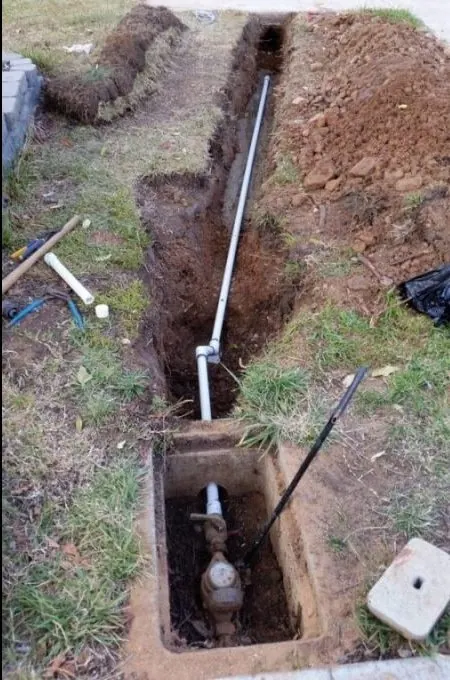
- Find the meter. In most San Diego neighborhoods it sits in a concrete box near the curb or sidewalk. Pry the lid up with a screwdriver, not your fingers. Meter boxes are a favorite spot for spiders.
- Watch the leak indicator. Most meters have a small low-flow indicator, a triangle, star or tiny dial that turns with even a trickle. Digital meters may show a flow symbol instead. If it moves, water is going somewhere.
- Run the slow test. Nothing moving? Write down the full reading, use no water for an hour or two, and read it again. Any change points to a slow leak.
- Split the house from the yard. Close your home's main shut-off valve and check the meter again. Still moving means the leak is outside, in the line from the meter or the irrigation. Stopped means it's inside.
- Rule out the toilets. Put a few drops of food coloring in each toilet tank and wait 15 minutes without flushing. Color in the bowl means a leaking flapper, one of the most common silent leaks there is.
Drain leaks don't move the meter, because that water already passed through it on the way to the faucet. A damp sink cabinet with a still meter usually means a leaking trap, drain joint or garbage disposal, not a supply pipe.
Where leaks hide in San Diego homes
Once you know a leak exists, the question is where. A leak inspection works through these spots.
Toilets
A worn flapper or a fill valve that never fully shuts off. No puddle, just water running quietly down the drain.
Under the sinks
Supply lines and the small valves they connect to. Look for drips at the nuts, crust on a valve, or a swollen cabinet floor.
At the water heater
Connectors on top, the relief valve and its discharge pipe, the drain valve. The leaking water heater page explains each spot.
Attic and ceilings
Where pipe runs overhead, a failed fitting can drip into insulation for weeks. A brown ring on a ceiling is worth a look.
Under the slab
Many San Diego tract homes sit on a concrete slab. A warm patch of floor or the sound of running water with everything off are the classic clues.
Outside
Hose bibs, sprinkler valves and the main line. A strip of lawn that stays green or soggy through a dry month is often the giveaway.
Some leaks, especially under a slab or deep inside a finished wall, can't be pinned to the exact spot just by looking. When the clues point there, Angel explains what he found and what the options are before anything gets opened up.
Leaky pipe repair: what fails and how it gets fixed
Most leaky pipe repair comes down to one of three problems, and each says something about the rest of your plumbing.
A failed fitting or joint
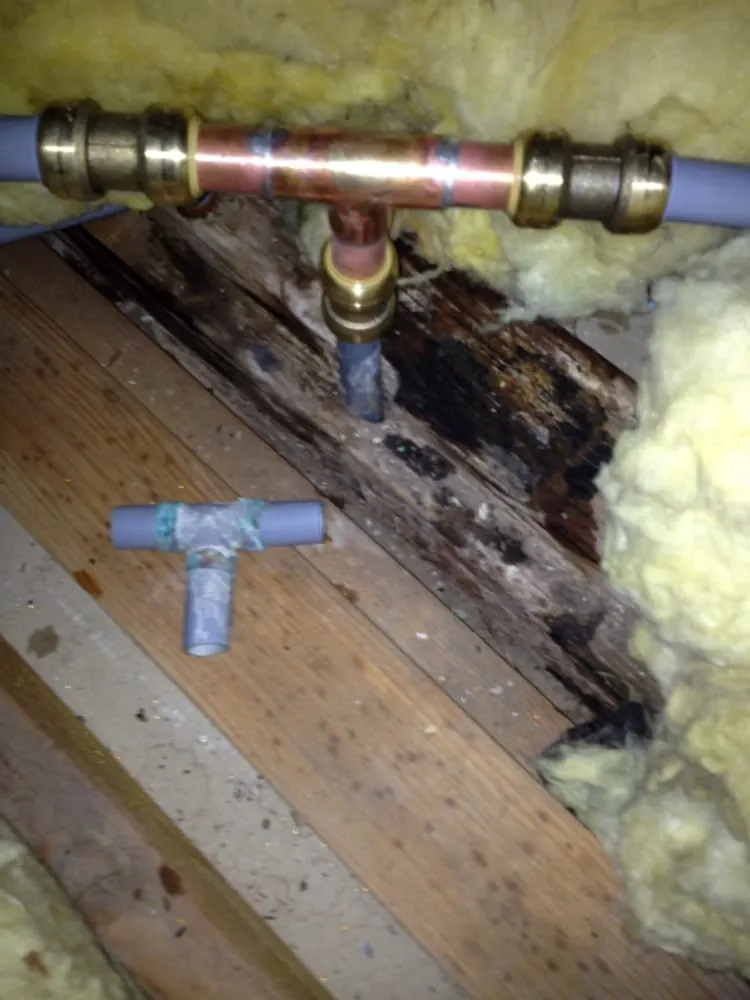
Tees, elbows and threaded joints are the weak points of any water line. The fix is to cut out the bad section, put in new fittings, and check the work at full pressure. If the pipe on either side is sound, that's the end of it.
A pinhole in copper
A fine spray, a drip from the middle of a straight run, or a spot of green crust. One pinhole is a routine repair. Pinholes in different rooms over a couple of years are a pattern, and that's when a repipe belongs in the conversation.
Old galvanized pipe
Galvanized steel rusts from the inside out. A leak at one threaded joint usually means its neighbors aren't far behind, and the rust narrows the pipe, which is why older galvanized homes often have weak pressure too.
Shut-off valves, including the one on your water heater
Shut-off valves sit untouched for years, so they tend to fail the one time you need them.
- Water heater shut-off
- The valve on the cold line above the tank, often called the hot water shut-off. Older ones are gate valves with a round wheel handle that seize, weep at the stem or never quite close. Water heater shut-off valve replacement usually means swapping in a quarter-turn ball valve.
- Main shut-off
- Where the water line enters the house, often near the front hose bib or in the garage. If it's stuck or hard to find, sort that out before a burst pipe makes it urgent.
- Fixture stops
- The small valves under each sink and behind each toilet. Old multi-turn stops often start dripping right after they're turned for the first time in years.
A drip from the pipes on top of the water heater is usually a connector, not the valve. If the drip comes from the relief valve's discharge line, the "overflow pipe" down the side of the tank, high pressure or thermal expansion is a common cause.
Water pressure and pressure regulators in San Diego
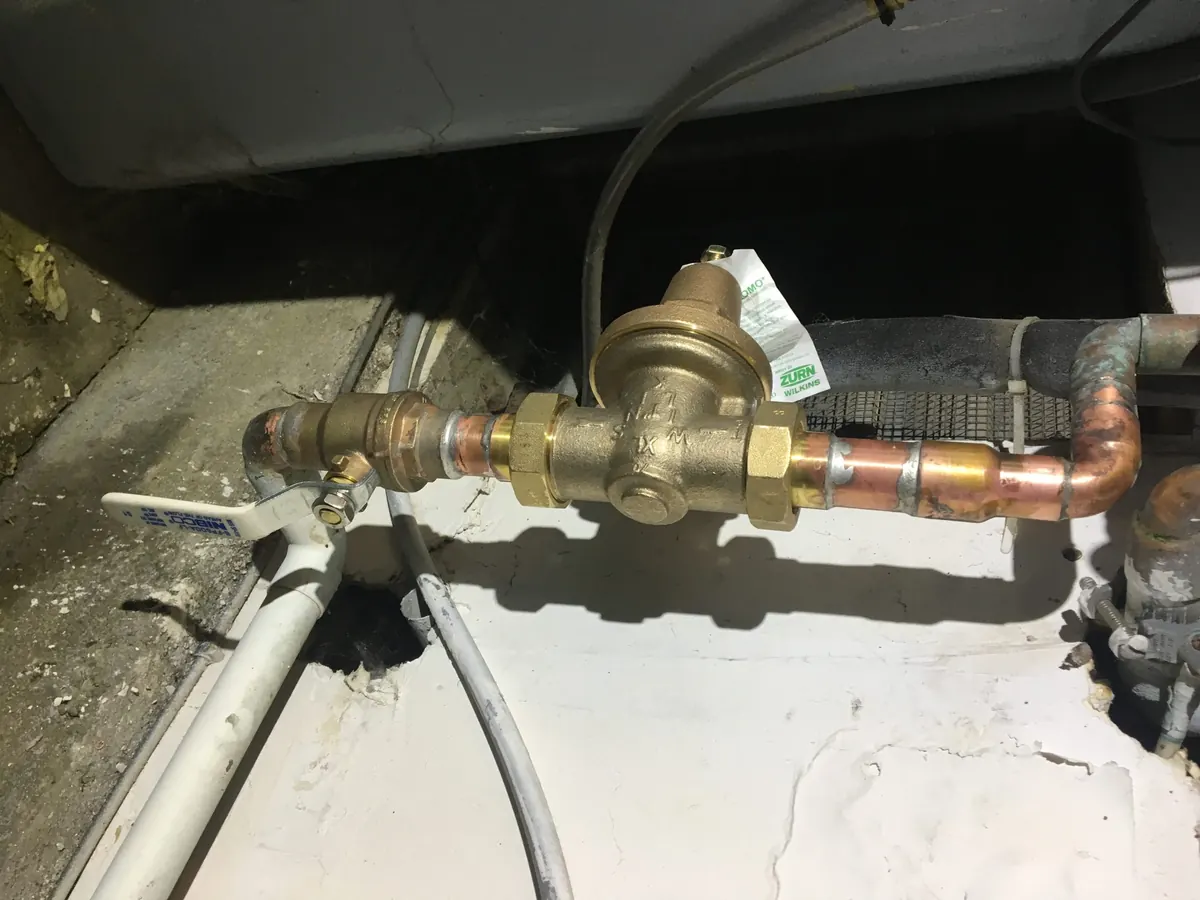
A pressure regulator, or PRV, is the bell-shaped brass valve on the main line, like the one at the top of this page. It steps the street pressure down to something your pipes, faucets and water heater can live with. California's plumbing code calls for one when supply pressure runs above 80 psi, and with San Diego's hills, street pressure can vary a lot from one block to the next.
Check yours with a hardware-store gauge that threads onto an outdoor hose bib. Read it during the day and again late at night, when demand drops and a worn regulator tends to let pressure climb.
| Gauge reads | What you'll notice | What it usually points to |
|---|---|---|
| Under about 40 psi | Weak showers, two fixtures can't run at once | A regulator stuck low, a partly closed main valve, or narrowed galvanized pipe |
| About 40 to 70 psi | Nothing in particular, which is the point | The comfortable range for most homes |
| Over 80 psi | Banging pipes, toilets that hiss, a dripping relief valve on the water heater | No regulator, or one that has failed open |
Regulators wear out like any valve with a spring and diaphragm inside. Replacing one means shutting the water off, cutting the old valve out, and setting the new one to the pressure your house needs.
If only one fixture is weak, the regulator is probably fine; a clogged aerator or worn cartridge is likelier, and that's faucet and shower repair. If only the hot side is weak, look at the water heater, where sediment is a common cause covered under water heater maintenance.
With a regulator in, water that expands as the heater warms it can't push back into the street, so house pressure spikes. An expansion tank absorbs that. If you're adding or replacing a regulator, check whether your heater has one.
Questions about leaks, pipes and pressure
Can I have a water leak without seeing any water?
Yes. A leaking toilet flapper, a broken sprinkler line underground or a pipe under the slab can run for months without a puddle. A jump in the water bill is often the only sign. Checking the water meter with every fixture off tells you for sure.
Who is responsible for a leak at the water meter?
In general, the water utility owns the meter and the pipe on the street side of it, and the homeowner owns the line from the meter to the house. If water is bubbling up inside the meter box or at the curb, call your water utility first.
What water pressure is normal for a house?
Most homes do well somewhere around 40 to 70 psi. California's plumbing code calls for a pressure regulator when the supply is over 80 psi. A reading above that, or one that swings a lot between day and night, means the regulator is missing or failing.
How do I know if my pressure regulator is going bad?
Watch for pressure that creeps up over time, pipes that bang when a valve closes, toilets that refill on their own, and a water heater relief valve that drips. A sudden drop at every fixture can also mean it has failed closed. A gauge at a hose bib confirms it either way.
Should I replace the old gate valve above my water heater?
If it's the round wheel-handle type and has been there for years, it's a good idea. Gate valves tend to seize or stop closing fully, and that valve has to work the day the heater leaks. A quarter-turn ball valve is the usual replacement.