Where Del Mar's tap water comes from
Inside the city limits, your water utility is the City of Del Mar, not the City of San Diego. The route your water takes is a little unusual, and the city's 2025 Annual Drinking Water Quality Report spells it out:
- Del Mar buys untreated water from the San Diego County Water Authority, which gets it from several sources, the Metropolitan Water District of Southern California among them.
- The City of San Diego treats it for Del Mar at the Miramar Water Treatment Plant.
- The treated water is pumped to Del Mar and stored in the city's four drinking water reservoirs.
- It reaches your meter through Del Mar's own distribution system.
So the minerals in a Del Mar tap are whatever Miramar sends out. Not sure which utility serves your address? The water bill settles it.
What the water report means for a Del Mar water heater
Del Mar's water met every safety standard. Three numbers in the report matter for your water heater.
| 2025 reading | Result | What it does in a water heater |
|---|---|---|
| Total hardness | 242 ppm average, 200–285 range (14.1 grains per gallon) | Minerals drop out as water heats: sediment in a tank, scale in a tankless heat exchanger. |
| pH | 8.27 average | Slightly alkaline. At the same hardness, higher pH pushes water toward forming scale rather than dissolving it. |
| Sulfate | 162 ppm average | Bacteria turn it into the rotten-egg smell when warm water sits still in a tank. |
A gas or electric tank here collects sediment every year it runs, and a yearly flush keeps it from packing into a crust the burner or element must heat through. A tankless heater needs descaling at least once a year; at 14 grains, a skipped year tends to show up as temperature swings and error codes.
Salt air and outdoor water heaters in Del Mar
A heater inside a garage or closet barely notices the ocean. One mounted on an outside wall does. Salty air corrodes exposed metal faster here than a few miles inland, starting small at fittings and fasteners.
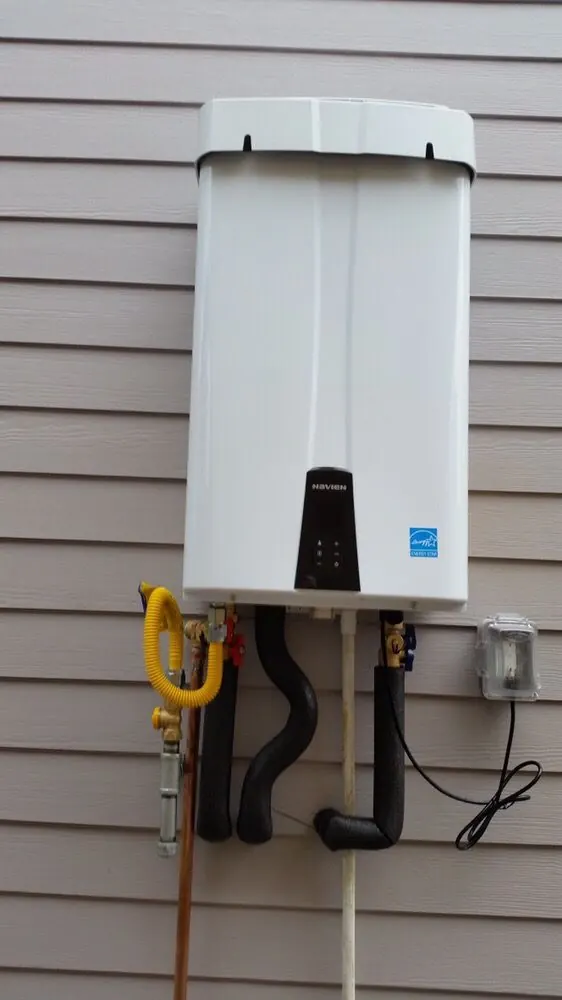
If yours lives outside, look these parts over a couple of times a year, and mention anything you find when Angel comes out:
- Vent and air openings. Salt crust, rust or debris there changes how the burner breathes.
- The gas valve and connector under the unit. Surface rust on the valve body is an early warning, not something to wait out.
- Water connections and service valves. White or green crust at a joint usually means a slow weep.
- The cover, screws and electrical outlet. A gas tankless unit still needs power for its fan and controls, so a cracked outlet cover matters.
Putting in a new unit? Ask about the side of the house that faces away from the ocean wind, or an indoor spot. That's part of planning any tankless installation on the coast.
Del Mar houses, and where the heater ends up
The city's Housing Element, using 2013–2017 Census estimates, puts about 29 percent of them in the 1970s, 24 percent in the 1960s and 15 percent in the 1950s, and counts 69 percent as single dwelling units. After decades of remodels, the heater can be in the garage, a closet, a later utility room or on an outside wall.
- A closet sized for an older tank
- A new tank can be a little wider or taller than the one it replaces. Measure the closet and its door before picking a size, and remember a gas tank also needs its vent and combustion air.
- An addition far from the heater
- A new primary bath at the other end of the house means a long wait for hot water. Bring it up on the estimate, because it can change where the heater should go.
When the Del Mar house sits empty
Del Mar has an unusual share of part-time homes. The Housing Element counted 24 percent of the city's housing as vacant in 2017, and about half of those units were held for seasonal, recreational or occasional use.
- Turn a gas heater to its vacation or pilot setting, or switch off the breaker for an electric one.
- Close the cold-water valve above the heater, or the house main if nobody will check in. A leak in an empty house runs until someone notices.
- If a neighbor or property manager looks in, show them the heater, its drain pan and the shut-off.
When you're back, run the hot taps for a few minutes before you use them.
Getting to Del Mar from Peñasquitos
It's a straightforward drive for Angel: SR-56 west through Carmel Valley to I-5, then off at Del Mar Heights Road or Via de la Valle and into town.
Del Mar water heater questions
Is Del Mar's water from the City of San Diego?
Partly. The City of Del Mar runs its own water utility and buys untreated water from the San Diego County Water Authority. The City of San Diego treats it at the Miramar Water Treatment Plant, and it's stored in Del Mar's four reservoirs. In 2025 it averaged 242 ppm of hardness, or 14.1 grains per gallon.
Why does the hot water smell like rotten eggs after the house sat empty?
Warm water sitting still in a tank lets certain bacteria turn sulfate into hydrogen sulfide gas, and the tank's anode rod helps that reaction along. Del Mar's water carried about 162 ppm of sulfate in 2025. Running the hot taps usually clears it; if the smell keeps returning, have the anode looked at.
Can I put a tankless water heater on the ocean side of my Del Mar house?
You can, but it's the hardest spot for it. The wall facing the onshore wind collects the most salt, so its fittings, valves and vent corrode first. A sheltered wall or an indoor spot is easier on the unit.
Should I worry about copper or lead from the plumbing in my Del Mar home?
The city's July 2024 samples from residents' taps came in well under the limits: copper at 0.402 ppm against a 1.3 ppm action level, lead at 2.26 ppb against 15 (90th percentile), and five more samples in 2025 were also below. Those metals mostly come from household plumbing, so if you're concerned, the report suggests having your own water tested.