Sizing a tankless water heater: gallons per minute, not gallons
A tank is sized by how much hot water it holds. A tankless unit holds almost none, so the question becomes: how much hot water does your house pull at its busiest moment, and how much does it need warming?
- Flow rate
- Add up the hot water fixtures that run at once. Showerheads sold in California flow 1.8 gallons per minute or less, and bathroom faucets less than that. Two showers going while the dishwasher fills is a typical morning peak, and it's the number the unit has to keep up with.
- Temperature rise
- The gap between the water coming in and the temperature you want out. San Diego's supply water is mild, but it runs cooler in winter. A unit is sized for the coldest morning of the year, because the bigger the rise, the fewer gallons per minute any heater can deliver.
- Burner size
- Each gas model has a maximum firing rate in BTUs. A bigger burner covers more flow, and needs a gas line that can feed it.
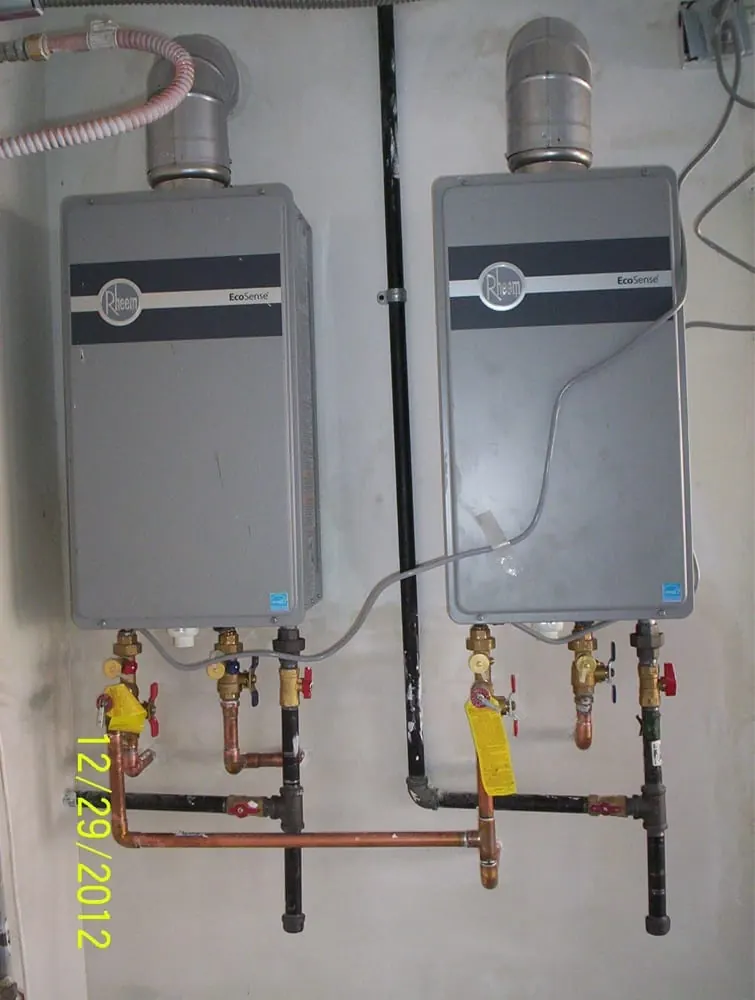
That's why Angel sizes tankless on site instead of by square footage. He counts bathrooms, asks how your household actually uses hot water, and picks a model with some room to spare. Larger homes sometimes get two units piped together to share the load. To see how tankless stacks up against a tank or a hybrid, the water heater guide compares all three.
Replacing a tank with a tankless water heater: what the conversion involves
A tank-to-tankless conversion is a different job from a tank-for-tank replacement. Here's the work, in the order Angel plans it.
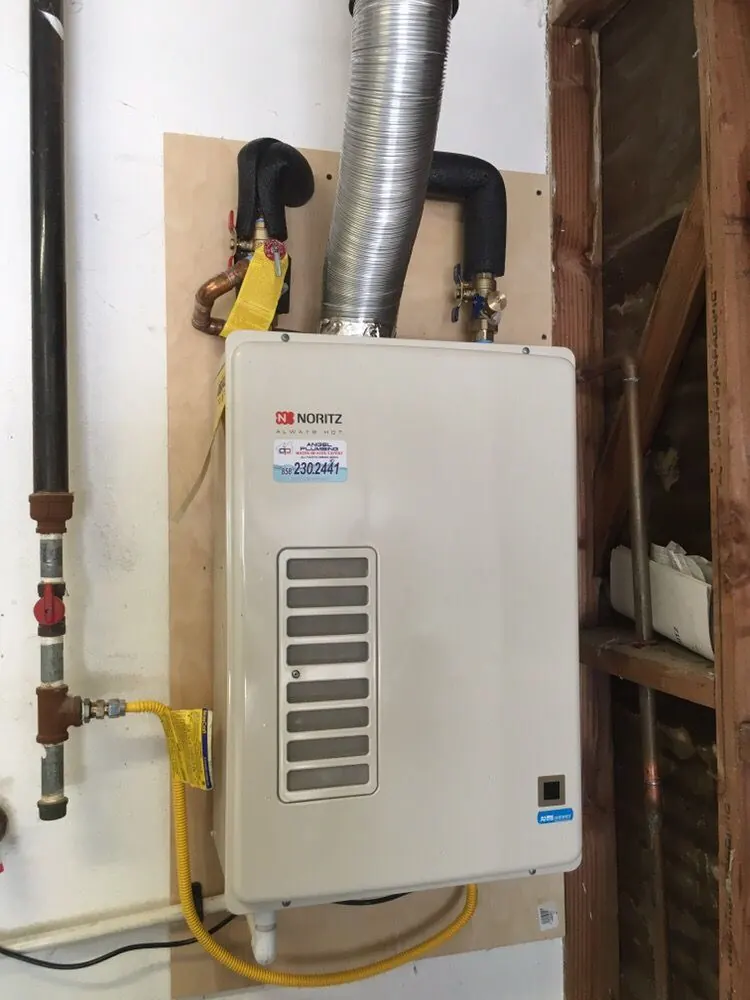
- Pick the spot. A tankless unit hangs on a wall, so it doesn't have to go where the tank stood: the same garage wall, an outside wall, or a closet with a workable vent path. Every foot it moves adds pipe and gas line.
- Size and route the gas line. At full fire, a gas tankless burner uses several times as much gas as a typical tank burner. The existing line was sized for the tank, so its size and its length from the meter get checked. It often has to be upsized or rerouted.
- Reroute the water lines. The hot and cold lines are brought to the unit's connections, and the unit gets a pair of service valves. Those valves are where the descaling pump hooks up each year.
- Run new venting. The metal flue from a gas tank can't be reused for most tankless models. The unit gets its own sealed vent through the wall or roof, with code clearances from windows and doors. High-efficiency condensing models vent through plastic pipe and also need a drain line for the condensate they produce.
- Bring power to it. A standard gas tank usually needs no electricity. A tankless unit does: an outlet nearby runs its fan, controls and ignition.
- Hook up, purge and fire. The old tank is drained, removed and hauled away. The new unit is mounted, connected and filled, air is purged from the lines, and the hot water is tested at the fixtures before Angel leaves.
Not every house needs all six. A short path from the meter to a garage wall keeps the job close to a straight swap. A unit that moves across the garage needs a new gas run. That difference is most of what you'll see on the estimate.
Indoor or outdoor tankless installation?
San Diego's mild weather makes outdoor installs practical in a way they aren't in much of the country. Both work well.
| Indoor: garage, closet, utility room | Outdoor: exterior wall | |
|---|---|---|
| Venting | Needs a vent pipe out through a wall or the roof | Vents straight from the unit's cabinet |
| Space | Takes a section of wall inside | Frees the garage or closet completely |
| Weather | Protected from sun and salt air | Exposed, so placement matters, especially near the coast |
| Power | A standard indoor outlet | A weatherproof outdoor outlet, kept on for the built-in freeze protection |
| Fan noise | Inside the house, usually in the garage | Outside, so keep it away from bedroom windows |
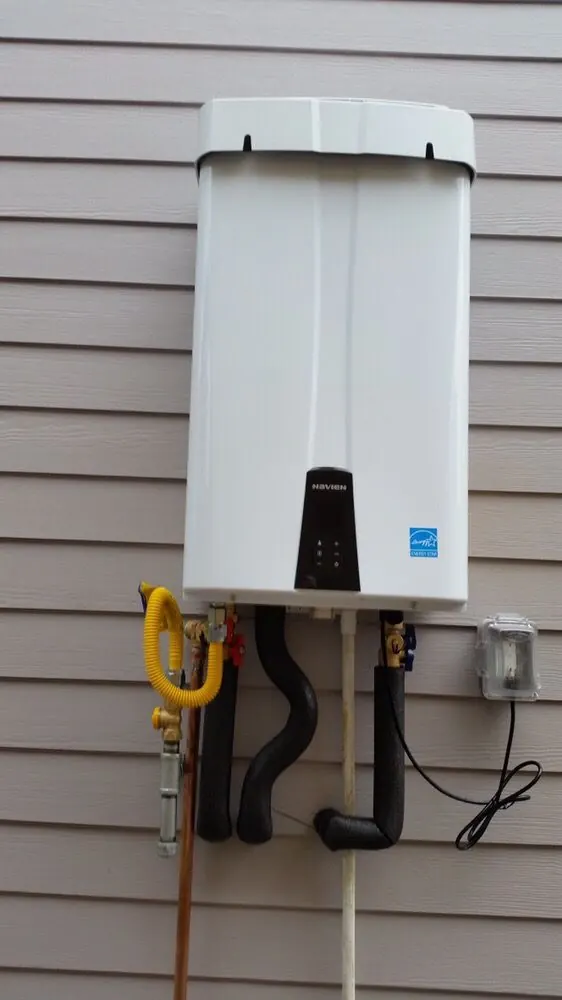
Near the coast, salt air is hard on anything metal that lives outside, so a sheltered wall or an indoor spot is worth considering. Inland, the bigger question is which outside wall gives the shortest gas and water runs.
Navien vs Noritz tankless water heaters (and Rheem)
These are the tankless brands Angel installs. All three make solid gas units; the differences are in the lineups.
- Navien
- A Korean manufacturer best known in the US for condensing tankless units. Some Navien models have a recirculation pump and a small buffer tank built in, which gets hot water to a far bathroom sooner. Outdoor versions are available.
- Noritz
- A Japanese manufacturer with a long history in tankless. Noritz makes condensing and non-condensing models for indoor and outdoor installs, including a line built specifically to replace a standard tank with less rework.
- Rheem
- The same company behind many of the tank heaters already in San Diego garages. Rheem makes condensing and non-condensing tankless units, and two can be linked to serve a larger house.
The brand matters less than the right size, a gas line that can feed it, a clean vent run and yearly descaling. Angel recommends a specific model on the estimate. Replacing an old tankless unit, from any brand, is usually simpler than a first-time conversion, because the gas line and vent are often close to what the new one needs.
Gas vs electric tankless
Most San Diego homes with a gas tank go to a gas tankless unit: the gas service is already there, and a gas burner handles a whole house's flow easily. A whole-house electric tankless unit draws a lot of current and usually needs several large dedicated 240-volt circuits, more than many older panels have room for. A small electric unit for a single sink is far simpler. If your home has no gas, a hybrid heat pump water heater is often the more practical electric option.
What drives the cost of a tankless water heater installation
Tankless installation cost varies more than a tank swap does, because the house decides how much work there is. These are the things that move the price:
- The unit: condensing or non-condensing, indoor or outdoor, and how big a burner your hot water use calls for.
- The gas line: whether the existing line can feed the new burner or a larger line has to come from the meter.
- The vent run: a short run straight through a garage wall costs less than a long path up through the roof.
- Relocation: moving the unit means new water and gas piping to the new spot.
- Power and drainage: an outlet if there isn't one, and a condensate drain for condensing models.
A tankless system costs more up front than a tank. What you get for it is hot water that doesn't run out, a unit off the floor, and a heater that usually outlasts a tank when it's descaled every year. Because the price depends on things Angel has to see, the estimate is free and in person.
What Angel looks at on the free estimate
- Where the current heater sits, and where a tankless unit could go
- The gas meter, the line feeding the heater, and the other gas appliances that share it
- The cleanest vent path and its clearances from windows and doors
- How many fixtures run at once, and how far the farthest bathroom is
- Whether there's an outlet nearby and a place for condensate to drain
You'll get a model recommendation, the reasoning behind it and a price for the whole job. Then you decide. After the install, plan on descaling at least once a year, as explained on the tankless repair and maintenance page.
Tankless installation questions
Do I need a bigger gas line for a tankless water heater?
Often, yes. A gas tankless burner at full fire uses several times as much gas as a typical tank burner, and the line that fed your tank was sized for the tank. The line size, its length from the meter and the other appliances on it all get checked on the estimate.
Does a gas tankless water heater work during a power outage?
No. Gas tankless units need electricity for the fan, controls and ignition, so no power means no hot water. A standard gas tank with a standing pilot keeps heating through an outage.
Will I really never run out of hot water with tankless?
As long as your use stays within the unit's flow rate, yes: it heats for as long as water flows. If too many fixtures run at once for its size, the water gets cooler instead, which is why sizing matters. A few seconds of cooler water between back-to-back uses is normal on many units.
How long does a tankless water heater last?
With yearly descaling, gas tankless units often last 20 years or more, noticeably longer than a typical tank. Skipping the descaling is the most common way to shorten that, especially with San Diego's hard water.