How long is a water heater warranty?
On tank water heaters, factory warranties run from 6 to 12 years. Manufacturers sell the same size tank in several tiers, and the warranty is one of the main things that separates a basic model from a premium one.
| Factory term | Where you'll see it | Worth knowing |
|---|---|---|
| 6 years | Entry-level models | Same size and fuel as the others, usually the lowest price. |
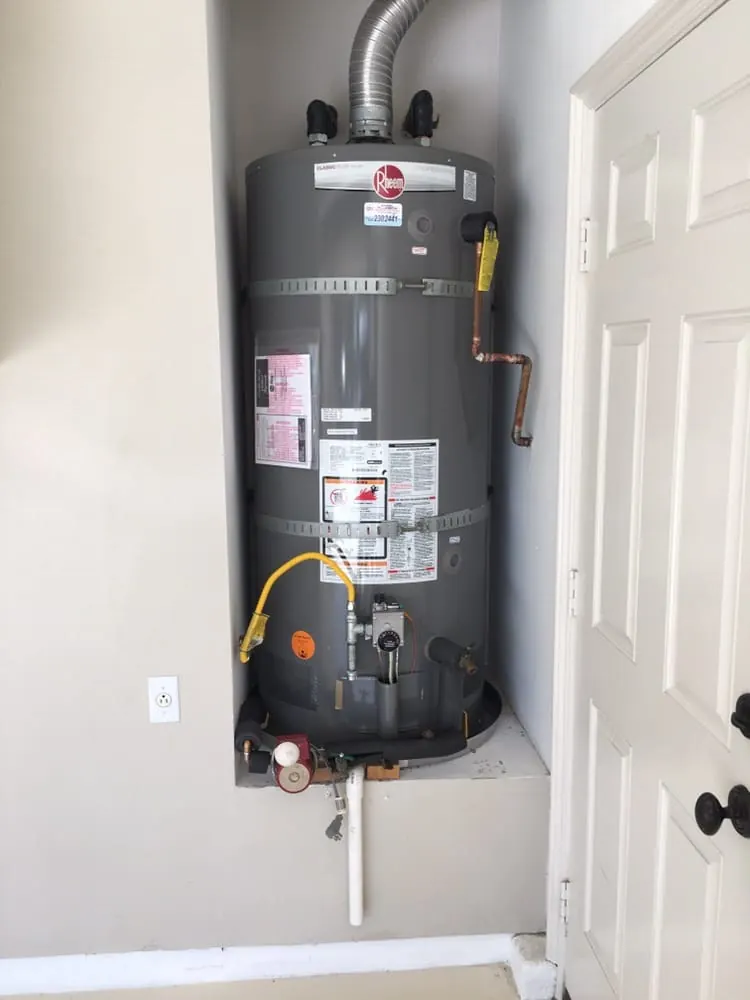
| 8 to 10 years | Mid-range models | Often a heavier anode rod or upgraded parts. The 75-gallon Rheem pictured below is an 8-year model. |
| 12 years | Top-tier models | Usually the most anode protection and the longest coverage on the tank. |
The clock typically starts on the install date if you can prove it, and on the manufacture date if you can't. That gap can be several months, which is why the paperwork section below matters.
What a water heater warranty covers, and what it doesn't
A "12-year warranty" sounds like 12 years of free repairs. It usually isn't. Most tank warranties split coverage into separate pieces:
- The tank
- The main promise. If the tank leaks within the term, the manufacturer typically provides a replacement heater of the same or a similar model.
- Parts
- Gas valves, thermocouples, heating elements and thermostats often have their own term, which can be shorter than the tank's.
- Labor
- Covered for a short time on some models, and not at all on many. Installing the replacement tank or part is usually on you.
- Everything around it
- Haul-away, new connectors, code updates like straps or an expansion tank, and the difference for a bigger or different model are typically not covered.
So when a tank fails under warranty, the heater may be free while the installation still costs something. Angel reads the label first, so the estimate shows which pieces the manufacturer is likely to pick up.
Can you extend a water heater warranty?
Sometimes. Some models accept an extended-warranty kit that adds 4 more years to the factory term. Not every model does, and an extension has to be added on the manufacturer's terms, so the best time to ask is while you're choosing the heater, not after it starts leaking.
An extension is worth asking about when:
- You plan to stay in the house well past the factory term.
- A failure would be costly where the heater sits, like an interior closet or a condo with neighbors below.
- You're buying a mid-range model and want coverage closer to a top-tier one. An 8-year tank plus 4 years reaches 12.
- You're in an area with hard water, which covers most of San Diego, and would rather not bet on the tank's last few years.
It's less useful if you're selling soon, since tank warranties often stay with the original owner, or if you're already buying a 12-year model.
A manufacturer's extension and a home warranty plan are different things. A home warranty is a service contract from a third-party company, with its own limits, exclusions and service fees, and it doesn't change what the manufacturer covers.
Gas vs electric water heater warranties
The structure is the same for both: a term on the tank, a term on the parts, and little or no labor. What differs is the parts list. A gas water heater warranty covers the gas control valve, the thermocouple or flame sensor, and burner parts. An electric water heater warranty covers the heating elements and thermostats. The gas valve is one of the priciest parts on any tank, so on gas units the parts term is the line worth reading.
Tankless and heat pump models split coverage differently, with separate terms for the heat exchanger or the compressor. Tankless warranties also often depend on regular descaling, which matters with San Diego's hard water. See tankless maintenance and descaling and heat pump water heaters.
Registration, the label and your receipt
Three things decide whether a claim goes smoothly. Keep them together, in a phone album or taped inside a cabinet door.
- Register the heater. Most manufacturers ask you to register online within a set window after installation. Some don't require it for California residents, but a registered heater makes any claim faster. Check your model's terms.
- Keep the invoice. Proof of the install date is what starts the clock. Without it, manufacturers typically count from the date the tank was built.
- Photograph the rating label. It lists the model and serial number. The serial number usually encodes the manufacture date, and the model number identifies the warranty tier.
Lost the paperwork? A clear photo of the label still gets you most of the way. Text it to Angel and he'll tell you roughly how old the heater is and whether it may still be covered.
What can void a water heater warranty
Exact terms vary by model, so read yours. These show up in a lot of tank warranties:
- An installation that doesn't follow local code or the manufacturer's instructions
- Damage from sediment or scale buildup in the tank
- Excess pressure, including thermal expansion on a closed system with no expansion tank
- A missing, blocked or capped T&P relief valve
- Fire, flood or freezing, or a heater moved from where it was first installed
Some manufacturers also require a licensed installer. Angel has held a California C-36 plumbing license since 2011, CSLB #967619, and every install follows the plumbing code.
How a warranty claim usually works
When a covered tank leaks, the model and serial number go to the manufacturer, or to the store or supplier the heater came from. They confirm the dates and the coverage, and the replacement heater or part usually comes through a local supplier. Installing it is a separate job, and that's where labor, haul-away and any code updates come in.
Before you start a claim, make sure the tank is really what's leaking. Water on top often comes from a connector or fitting, which is a simple repair, not a warranty case. The leaking water heater page shows how to tell. And a warranty doesn't make a tank last longer; a yearly flush does. See water heater maintenance.
Water heater warranty questions
Does a water heater warranty cover labor?
Usually only for a short time, if at all. Many tank warranties cover the tank and parts for years but labor for a year or less, so installing a warranty replacement is typically paid by the homeowner. Look for the labor line in your model's terms. Angel's own warranty on his installation is separate from the factory's, and he'll go over what it covers when he quotes the job.
Does the warranty transfer if I buy a house with a newer water heater?
Often not. Many tank warranties cover only the original owner at the original address, though some do transfer. Ask the seller for the invoice and registration, then check the manufacturer's terms for that model.
Can I add an extended warranty to the water heater I already have?
Possibly, but it depends on the model and how long ago it went in. Extension kits only fit certain models and are added on the manufacturer's terms, which usually means close to the install date. Send Angel a photo of the label to find out if yours accepts one.
Is a longer water heater warranty worth paying for?
Usually, if you'll stay in the house past the shorter term. Longer-warranty tiers tend to come with more anode protection and better parts, so part of what you pay for is a tank built to last longer. If you expect to move within a few years, the basic tier is usually enough.
Is a water heater warranty counted from purchase or manufacture?
From the install date, if you can prove it with an invoice or registration. Without proof, manufacturers typically fall back on the manufacture date coded in the serial number, which can cost you a few months of coverage.