Scripps Ranch water starts at the Miramar plant next door
Few neighborhoods have their water plant inside the community. Scripps Ranch does. The City's Miramar Water Treatment Plant sits in Scripps Miramar Ranch, right next to Miramar Reservoir, and it treats drinking water for an estimated 500,000 customers across the northern part of the city. The reservoir was dedicated in 1960, the plant opened in 1962, and, as the City's reservoir fact sheet puts it, Scripps Ranch was developed a few years after the reservoir was finished.
On the City's service-area map, Scripps Ranch falls in the Miramar plant's area, so its column in the yearly report is the one to read. These are the hardness figures from the City of San Diego 2025 Annual Drinking Water Quality Report:
| Miramar plant, 2025 | mg/L (ppm) | Grains per gallon |
|---|---|---|
| Average total hardness | 242 | 14.1 |
| Lowest reading | 200 | 11.7 |
| Highest reading | 285 | 16.6 |
| Where USGS starts calling water "very hard" | Above 180 | About 10.5 |
| Top of the water-quality range in Navien and Noritz tankless documents | 200 | 12 |
Read the last two rows against the first three. Even the lowest Miramar reading of 2025 was above the USGS line for very hard water, and the average sat well past the limit two big tankless makers print. Navien's NPE installation manual lists hardness up to 200 mg/L and says damage from poor water quality isn't covered by the warranty. The tankless warranty Noritz posts excludes damage from water harder than 12 grains per gallon.
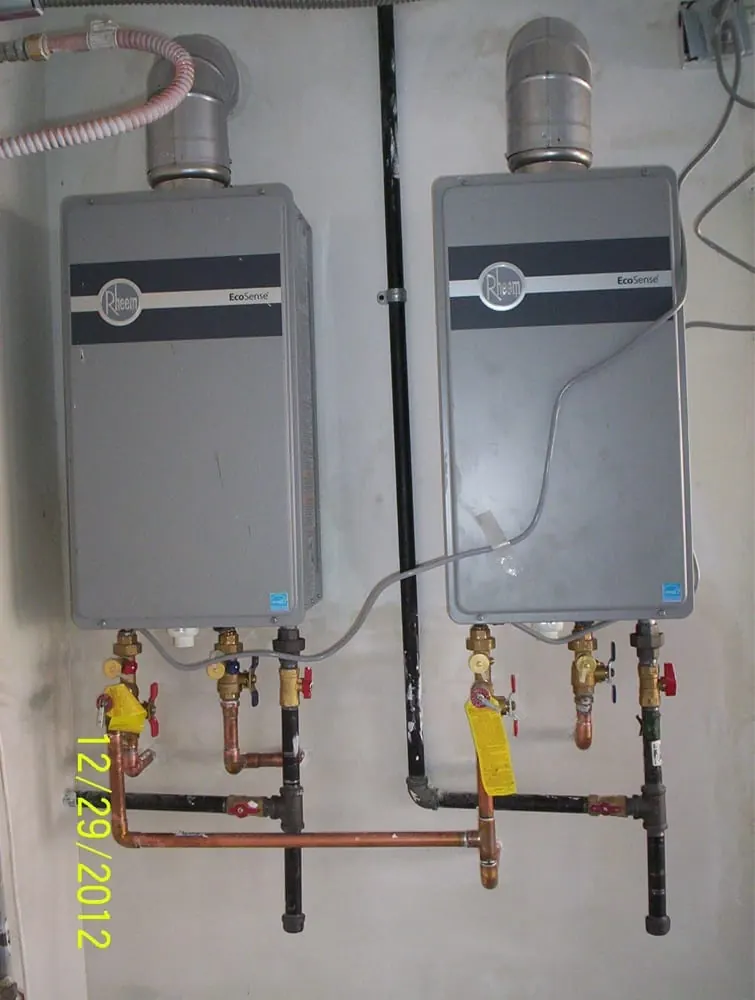
So the yearly service is a requirement here, not a nice-to-have. A tank needs its annual flush to keep sediment off the burner. A tankless unit needs its yearly descaling, and a big household running several showers every morning should stay on the early side of that schedule.
Under the City's Pure Water program, Miramar Reservoir will switch from holding imported water to holding purified water from the North City facility, which the Miramar plant then treats again. The last segment of the pipeline went in under Hoyt Park Drive in November 2026, and testing comes next. Any change in hardness will show up in a future report. Until then, plan around the numbers above.
Water heaters in homes rebuilt after the Cedar Fire
The Cedar Fire reached Scripps Ranch in October 2003 and destroyed 312 homes. By mid-2007, KPBS reported that virtually all of them had been rebuilt.
That left a whole group of houses whose pipes and first water heaters date from roughly 2004 to 2007. A tank from then is now around 20 years old, while most tanks give out somewhere in the 8-to-12-year range. A rebuild-era original that's still running is overdue, and if it was swapped once, the second one may be getting close.
- Find the date on the label. A 2004–2007 manufacture date on a rebuilt home usually means you still have the original. Plan the replacement before it plans itself.
- Look at the floor under the tank. Rust stains, a damp drip pan or white crust at the fittings on a 20-year-old tank are warning signs. The leaking water heater page explains what each spot means.
- Ask before draining a tank that's never been flushed. Twenty years of Miramar water can leave a thick bed of sediment, and opening the drain on an old tank sometimes starts a drip. If the heater is near the end anyway, put the money toward the new one.
Sizing a water heater for a bigger Scripps Ranch house
Scripps Ranch homes run large. Census figures for the 92131 ZIP (American Community Survey, 2020–2024, via Census Reporter) show about 49% of homes with four or more bedrooms, and a median of 6.3 rooms per home, against 5.0 in neighboring Mira Mesa. About 63% are detached houses, and the median one was built in 1993: about a third of today's homes went up in the 1990s, against about one in six in the 1970s.
Angel sizes by the house, not the headcount: about 1,600 sq ft or less, a 40-gallon tank; past that, 50 gallons or more, which describes much of Scripps Ranch. When a soaking tub and two showers run at once, the choice is usually between a 75-gallon tank (which can mean a gas line check, covered on the gas water heater page) and a tankless unit sized by flow rate. On a tankless conversion, Angel comes out for a free in-person estimate first.
The drive from Peñasquitos
Scripps Ranch sits just across I-15 from Angel's home base. For the southern half of the community, he takes Black Mountain Road south to Mira Mesa Boulevard, then east over the freeway to Scripps Ranch Boulevard. For the neighborhoods in the north, off Scripps Poway Parkway, it's Mercy Road across I-15 and onto the parkway. Scripps Ranch is also one of the names lettered on his van.
Next door, Angel also covers Mira Mesa across I-15, Poway to the east and his own Rancho Peñasquitos. See all service areas.
Scripps Ranch water heater questions
Which treatment plant supplies Scripps Ranch, and how hard is that water?
Scripps Ranch is in the service area of the City of San Diego's Miramar Water Treatment Plant, which sits beside Miramar Reservoir inside the community. In 2025 its water averaged 242 mg/L of total hardness, or 14.1 grains per gallon, with readings from 200 to 285 mg/L. The USGS classes anything above 180 mg/L as very hard.
My Scripps Ranch home was rebuilt after the 2003 Cedar Fire. Is the water heater due?
If it's the heater that went in during the rebuild, almost certainly. Those homes were rebuilt roughly between 2004 and 2007, so an original tank is about 20 years old, well past the usual 8 to 12 years. Check the manufacture date on the label, or text Angel a photo of it.
Is a 40-gallon tank enough for a four-bedroom house in Scripps Ranch?
Usually not. A 40-gallon tank suits homes up to about 1,600 sq ft, which usually means two or three bedrooms. A four-bedroom house is past that, so 50 gallons is the usual starting point. If several showers run at once, a 75-gallon tank or a tankless unit may fit better.
Can a tankless water heater cope with Scripps Ranch water?
Yes, if it's descaled every year. Miramar water averaged 14.1 grains per gallon in 2025, above the 12-grain limit in Navien and Noritz documents, so scale builds in the heat exchanger faster than it would in softer water. Skip the descaling and you risk both the heat exchanger and the warranty.