Where Escondido's tap water comes from
Water service in the Hidden Valley goes back 135 years, from the Escondido Irrigation District to the Escondido Mutual Water Company to today's city utility. The city's 2025 water quality report traces the path to your faucet:
- Local water. Water from the watershed and well fields near Lake Henshaw runs down the San Luis Rey River and a canal built in the 1890s to Lake Wohlford.
- Imported water. The rest is bought from the San Diego County Water Authority: Colorado River and Northern California water, which the city stores in Dixon Lake.
- One treatment plant. Both sources are treated at the Escondido-Vista Water Treatment Plant, which the city owns jointly with the Vista Irrigation District. It was built in 1976 and can produce up to 75 million gallons a day.
- Out to your street. From there it travels through more than 440 miles of pipeline.
Escondido water hardness: 188 in 2024, 215 in 2025
Treatment removes particles and germs, not the dissolved minerals that cause scale. Compare the city's last two reports:
| Measure | 2024 report | 2025 report |
|---|---|---|
| Hardness, as calcium carbonate | 188 mg/L (160–210) | 215 mg/L (210–230) |
| Grains per gallon | About 11.0 | About 12.6 |
| Calcium | 46 mg/L | 52 mg/L |
| Magnesium | 17 mg/L | 20 mg/L |
| Total dissolved solids | 498 mg/L | 527 mg/L |
Both years land in the USGS "very hard" range, which starts at 180 mg/L. The jump matters because scale builds faster with every extra grain. If you've been stretching the yearly tank flush, 2025's water is a reason to stop. On a tankless unit, a yearly descale is the minimum at 215, and a unit that was already short on descaling will show it sooner. The maintenance page covers what a flush involves.
The city's water service area doesn't line up exactly with the city limits. Next door is the Rincon del Diablo Municipal Water District, formed in 1954 to bring imported water to areas outside the city, and some of its territory has since been folded into the city's system (city environmental report). Your water bill says which one serves you. If it's Rincon, use Rincon's report, not the numbers above.
Inland heat and the Escondido garage water heater
Escondido is well inland. NOAA's 1991–2020 normals for the city's weather station put the average high at 87°F in July and 89°F in August, and the average low around 44 to 45°F in December and January. A closed garage holds a lot of that summer heat and gives some of it up on winter nights. That swing matters more to some water heaters than others:
Heat isn't the problem
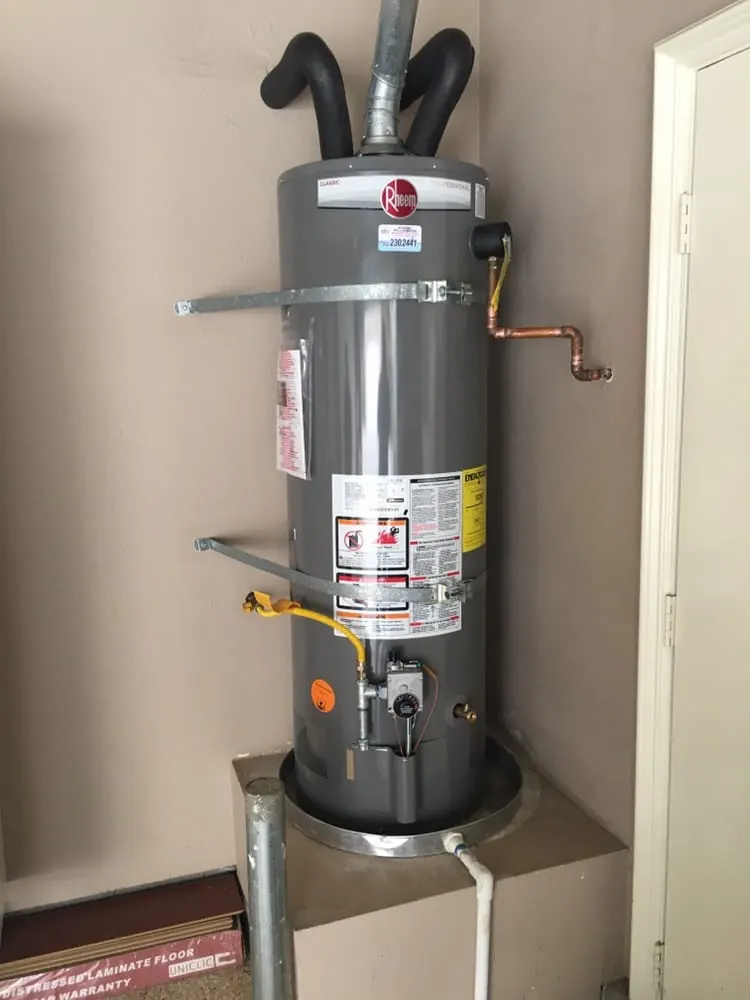
A hot garage doesn't bother a gas tank much. The hard water does. Plan on the yearly flush, and keep the burner area clear of stored boxes.
Best from spring to fall
It heats water by pulling warmth out of the garage air, so warm months are its best stretch. On cold nights it leans on its electric elements more. See hybrid water heaters.
No tank to keep warm
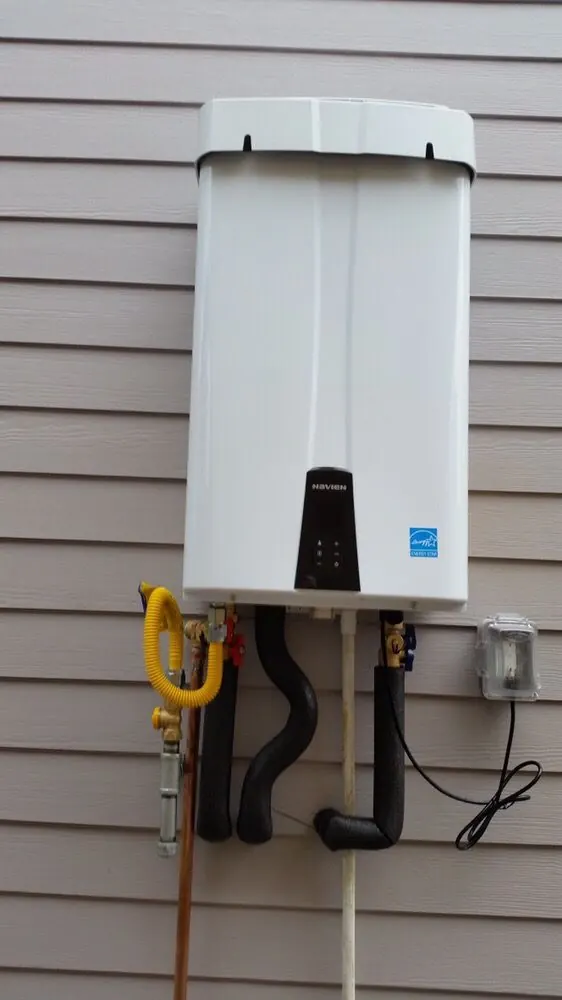
It heats only when a tap opens, inside or on an outside wall. At 215 mg/L the heat exchanger needs its descale every year without fail.
Condos without gas
If your unit has no gas line, it most likely has an electric tank. A hybrid can replace one when there's room and airflow around it.
Escondido plumbing in 1970s and '80s houses
The city's 2021–2029 housing element counts 27.6% of homes built in the 1980s and 25.8% in the 1970s, and more than a fifth before 1970. In 2020, about half the housing was single-family detached, 6% single-family attached and 36% apartments and condos.
One piece of good news: the city finished its service-line inventory and found no lead service lines in its system. The pipes on your side of the meter are a separate question. In a house that's 35 to 55 years old, these are what usually come up:
- A water bill that creeps up. Start with the meter test on the leak inspection page. If the meter moves with everything off, something is leaking, and finding it comes before any digging or wall opening.
- Leaks that keep coming back. When the same pipes fail again and again, patching stops making sense. That's the point where a repipe is worth pricing.
- Worn shower valves and faucets. Hard water is rough on cartridges and O-rings. A faucet that keeps dripping or a shower handle that turns stiff usually needs a new cartridge. See fixtures.
Escondido questions
Why did Escondido's water get harder in 2025?
The report doesn't give a reason. It shows average hardness rising from 188 mg/L in 2024 to 215 mg/L in 2025, with calcium and magnesium both up. The city blends local lake water with imported water, and the two don't carry the same minerals, so the number at your tap can move from year to year.
Does Escondido's water come from Dixon Lake?
Partly. Dixon Lake holds the city's imported water. Local water comes from the Lake Henshaw watershed by way of Lake Wohlford. Both are treated at the Escondido-Vista Water Treatment Plant before reaching your house.
Does Escondido have lead water service lines?
According to the city's 2025 water quality report, its completed service-line inventory found no lead service lines in the distribution system. That covers the city's lines. Pipes inside your property line are separate, and the report lists the city's water distribution number for lead questions.
Will a heat pump water heater keep up in an Escondido garage in winter?
Usually, yes. Winter lows here average in the mid-40s outside, and a closed garage stays somewhat warmer. On the coldest nights a hybrid runs its electric elements more, so it uses more power, but you still get hot water. Summer is when it saves the most.