Why so many 4S Ranch water heaters come due together
4S Ranch was a working ranch for decades, then a business park from 1987. The homes came last, and they came fast, which is why the same water heater question keeps coming up on street after street.
- 2001: home sales open at Amherst, one of the first neighborhoods, in October. A tank installed that year is 25 years old now.
- 2007: the Witch Creek Fire reaches the Rancho Santa Fe Fire Protection District. The district reports no structure losses in the 4S Ranch tracts, so there was no rebuild wave that reset heater ages.
- 2014: housing is completed. Even the newest original tank in the neighborhood is about 12 years old.
- Today: every original tank here has passed the usual 8 to 12 years. Many have been replaced once; the rest are on borrowed time.
The master association says more than a dozen builders worked on 4S Ranch, and it includes both single-family homes and condos. So don't assume your heater, its size or its spot in the garage matches the house next door. The label on your tank tells you what you actually have. Sources: 4S Ranch history, Rancho Santa Fe Fire incident archive, 4S Ranch Master Association.
Olivenhain water and what it does inside a heater
4S Ranch gets its water from the Olivenhain Municipal Water District, not the City of San Diego. In 2025, about 78% of the district's water was treated at its David C. McCollom Water Treatment Plant. The rest was bought already treated from the San Diego County Water Authority. The plant's hardness result for 2025 was 200 ppm, about 11.7 grains per gallon, according to the district's 2026 Consumer Confidence Report. Its potable water page says hardness can run up to about 250 ppm, roughly 15 grains.
The McCollom plant filters through membranes. Those catch particles and microbes, not the dissolved calcium and magnesium that make water hard. Here's what that hardness does to each type of heater.
- Gas or electric tank
- Heating pushes calcium carbonate out of the water, and it settles on the bottom of the tank as sediment. On a gas tank, that layer sits between the burner and the water, so the heater runs longer for the same shower and may pop or rumble. A yearly flush keeps it thin.
- Tankless
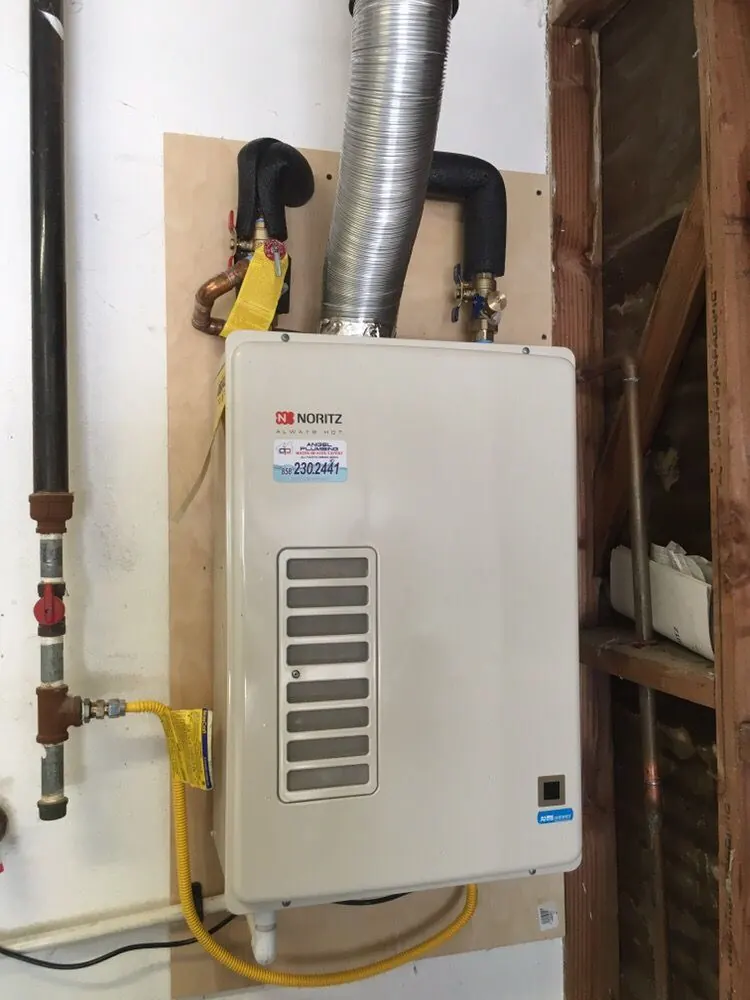
- Water races through a narrow heat exchanger at high temperature, and that's exactly where scale sticks. At around 12 grains, a yearly descale isn't optional. See tankless repair and descaling.
- Hybrid heat pump
- It's still a tank, so it gets the same sediment and needs the same yearly flush. The heat pump on top adds a condensate drain and an air filter to keep clear.
Another tank, or tankless?
Once a 4S Ranch tank is near the end, the choice comes down to how your household uses hot water and what's already in the garage.
| Question | New tank | Tankless |
|---|---|---|
| The install | About 2–3 hours, with the old tank hauled away | A bigger job: the unit often moves, and the water lines, gas line and venting get rerouted |
| Gas supply | The existing line usually works | Needs enough gas for a high-input burner, checked on the estimate |
| Venting | Reuses the existing flue if it's sound | A new vent run made for tankless |
| Hot water supply | A stored amount, then recovery time | Continuous, if the unit is sized for the showers running at once |
| Upkeep on this water | Yearly flush | Yearly descale with special equipment |
Angel gives free in-person estimates for tankless conversions, because the gas, venting and location questions can't be answered from a photo. If you'd rather stay with a tank, a standard replacement is the fastest way back to hot water. And since 4S Ranch is inland, garages run warm in summer, which suits a hybrid heat pump if you'd like to move off gas.
Getting to 4S Ranch from Peñasquitos
4S Ranch borders Rancho Peñasquitos to the south and Rancho Bernardo to the east. Angel's usual way in is a short hop up I-15 to Camino del Norte, then west into the neighborhood. Rancho Bernardo Road is the other main entrance. Neighbors over in Rancho Santa Fe and back home in Rancho Peñasquitos have their own pages, and the full list is on service areas.
Angel handles the rest of the house too: faucets, showers and toilets, garbage disposals and leaks and water pressure.
Before you call about a 4S Ranch heater
- Photograph the tank's label. The serial number usually encodes the year it was made.
- Note where it sits: on the garage floor, on a raised platform, or in a condo closet.
- Look for a small tank on the cold line above the heater. That's an expansion tank, and it gets checked during a swap.
- Check the drip pan and the floor. If there's water, start with the leaking water heater steps while you call.
4S Ranch water heater questions
Who supplies 4S Ranch's water, and how hard is it?
The Olivenhain Municipal Water District. Its 2026 report lists 200 ppm of hardness for 2025 at the McCollom treatment plant, about 11.7 grains per gallon, and the district says its water can reach about 250 ppm. That's hard enough that tank heaters need a yearly flush and tankless units a yearly descale.
How can I tell if my 4S Ranch water heater is the builder's original?
Compare the manufacture date on the tank's label with the year your house was finished. Most brands encode the year in the serial number. If the two match, it's the original, and since the last 4S Ranch homes were completed in 2014, any original is at least 12 years old.
Were 4S Ranch homes rebuilt after the 2007 Witch Creek Fire?
No. The Rancho Santa Fe Fire Protection District reports no structure losses in the 4S Ranch tracts from that fire. So the age of a 4S Ranch water heater traces back to when the house was built, or to whenever someone last replaced it.
Is tankless a good fit with Olivenhain water?
It can be, if you plan for the upkeep. At around 200 ppm, scale builds up in the heat exchanger, so a tankless unit here should be descaled at least once a year. If nobody will keep up with that, a new tank is the lower-maintenance choice.