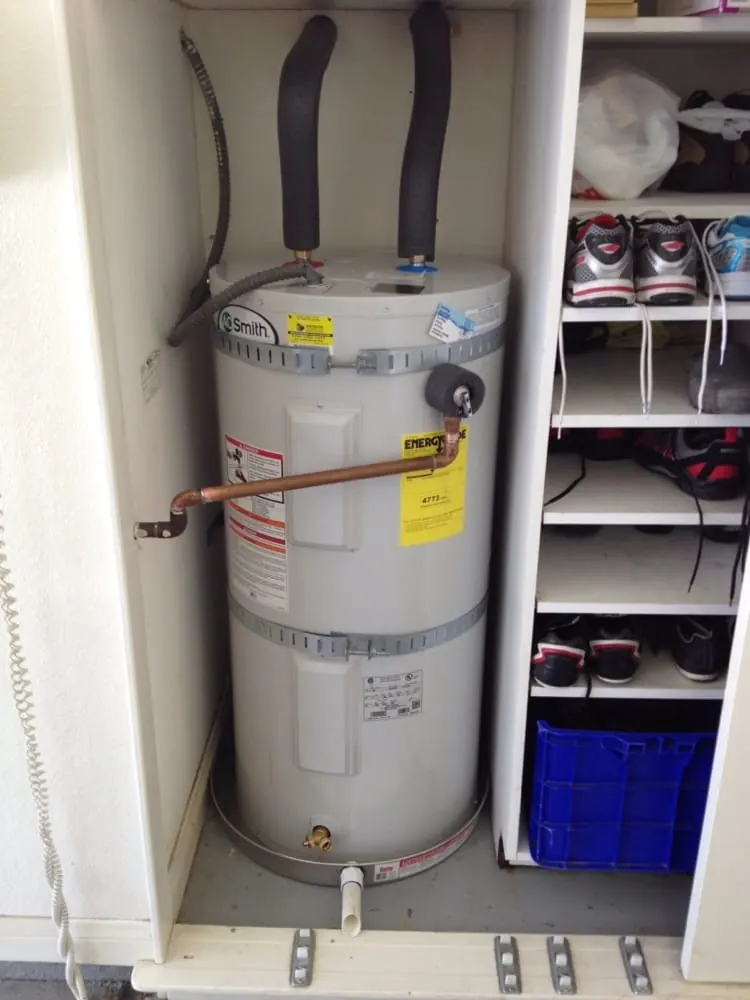
Inside an electric water heater, top to bottom
The photo at the top of this page shows a typical garage install. Here's what each part does, and which ones a replacement touches.
- Water lines on top
- Cold in, hot out, on two flexible connectors. Both are replaced with the tank.
- Junction box
- A small cover on top where the house wiring meets the heater. A 240-volt heater usually has two hot wires and a ground.
- T&P relief valve
- Opens if the temperature or pressure inside gets too high. Its copper discharge line carries that water away, down or out through the wall.
- Upper and lower elements
- Behind the two panels on the front, each with its own thermostat. In most home tanks only one heats at a time: the upper one first, then the lower one takes over.
- Anode rod
- A metal rod inside the tank that corrodes so the steel doesn't. Once it's used up, the tank starts to rust.
- Drain valve, pan and straps
- The valve at the bottom is for flushing. The pan catches drips, and two seismic straps hold the tank to the wall, as California code requires.
Elements and thermostats wear out and can be replaced on their own; the repair page covers testing them. When the tank itself leaks, it's time for a new heater.
Electric water heater replacement, start to finish
The job is close to a gas swap, minus the gas line and the vent. A like-for-like electric water heater installation covers:
- Breaker off, and the wiring confirmed dead before anything is touched
- Old tank drained, then the water lines, wiring and T&P line disconnected
- Old unit hauled away and disposed of
- A new drip pan, the new tank, and two seismic straps
- New hot and cold connectors, and the T&P line reconnected
- Wiring reconnected at the junction box
- The tank filled with a hot tap open until water runs without spitting air
- Power on, then checked for leaks and for heat from both elements
The full list of what every install includes, and what moves the price, is on the water heater replacement page.
An element that gets power with no water around it burns out within seconds. This is called a dry fire, and it can ruin a brand-new heater on day one. If you ever drain your tank, leave the breaker off until the tank is full and a hot tap runs steady.
The 240-volt circuit comes first
Most household electric water heaters run on 240 volts from a breaker of their own. The label on the tank lists the voltage and the element wattage, and 4,500 watts is the most common. A 4,500-watt heater is typically fed by a 30-amp double-pole breaker and 10-gauge copper wire.
Like for like keeps it simple: same voltage, same wattage, same circuit. Trouble starts when the new heater doesn't match, such as higher-wattage elements on a circuit sized for less. If anything about your circuit doesn't fit the new heater, it gets flagged on the estimate, before anything is ordered.
Recovery: why electric tanks run out sooner
A 50-gallon electric tank and a 50-gallon gas tank hold the same amount of water, but they reheat at very different speeds.
| Compared | Electric tank | Gas tank |
|---|---|---|
| Heat source | One element at a time, usually 4,500 watts | A burner, usually around 35,000–40,000 BTU |
| Reheat speed | Roughly 20 gallons an hour | Roughly 40 gallons an hour |
| Full tank from cold | Often around 1½ to 2 hours | Often under an hour |
| In daily life | Space out showers and laundry, or size up | Handles back-to-back showers better |
The yellow EnergyGuide label lists a first-hour rating: how many gallons of hot water the heater can deliver in an hour, starting full. It's a better comparison than tank size alone. The usual guide is 40 gallons for homes up to about 1,600 sq ft and 50 or more above that. With electric, if your home sits right at the line, the bigger tank is usually the safer pick.
Condos, townhomes and homes without gas
Electric tanks are common where gas never reached: many condos and apartments, some townhomes, and homes where the gas was capped off. With no flame and no flue, the heater can go in an interior closet, under the stairs or in a cabinet by the laundry, as long as there's room to get it in and out.
In a condo, the drip pan and its drain matter more than anywhere else, because a leak doesn't stop at your floor; it reaches the unit below. If your HOA has rules about water heaters, such as pans, replacement age or work hours, check them before you schedule. And tell Angel about the route when you call: a 50-gallon tank going up a flight of stairs or around a tight hallway corner is part of the plan.
From an electric tank to a heat pump
If you have an electric tank now, a heat pump (hybrid) water heater is the natural next step. Many run on the same kind of 240-volt circuit and heat water by pulling warmth out of the surrounding air, using much less electricity than elements alone. Before you switch, check four things:
- Air: it needs a good volume of air around it, so a tight closet may need a louvered door.
- Drain: it makes condensate, which needs somewhere to go.
- Height: hybrids are usually taller than a standard tank.
- Circuit: confirm the model's breaker size against the one you have.
Electric water heater leaking or not heating?
Lukewarm water, a tripping breaker or no heat usually traces to an element or thermostat; start with water heater repair. Water on the floor needs a different first step, covered on the leaking water heater page. San Diego's hard water also coats the lower element with scale, which a yearly flush helps with; see maintenance.
Electric water heater questions
What size breaker does an electric water heater need?
Most 4,500-watt, 240-volt tanks sit on a dedicated 30-amp double-pole breaker with 10-gauge wire. The label on your heater lists its voltage and wattage, and the circuit has to match what that label calls for. Higher-wattage elements need a circuit sized for them.
Can I switch my electric water heater to gas?
Only if gas can reach the spot and the exhaust can be vented safely. That means running a gas line and adding a flue or power vent, which is often impractical in condos. If lower running costs are the goal, a heat pump hybrid is usually the simpler path.
Why is my new electric water heater taking so long to get hot?
Heating a full tank from cold on one 4,500-watt element takes a while, often an hour and a half to two hours. If the water is still lukewarm after several hours, or only the first few minutes of a shower are hot, one element or thermostat may not be working.
Do electric water heaters last longer than gas?
Often a little, since there's no burner, flue or combustion moisture wearing on the tank. It still corrodes from the inside once the anode rod is used up, so the age on the label matters just as much as it does on a gas heater.
Is a 120-volt electric water heater an option?
Small 120-volt tanks exist for a single sink or a very small space, but they reheat slowly and aren't meant to serve a whole house. Some newer heat pump models also run on 120 volts, which can help where there's no 240-volt circuit.