Carmel Valley water, by the numbers
Carmel Valley is part of the City of San Diego, so its water comes from the City's Public Utilities Department. The City runs three treatment plants with overlapping service areas, and its 2025 service-area map places Carmel Valley in the territory of the Miramar Water Treatment Plant, which serves an estimated 500,000 customers in the northern part of the city.
| Miramar plant, 2025 | Result | What it means for a heater |
|---|---|---|
| Total hardness, average | 242 ppm (14.1 grains per gallon) | Hard water: sediment in tanks, scale in tankless units |
| Hardness range | 200–285 ppm (11.7–16.6 grains) | Plan upkeep for the high end, not the average |
| Langelier index, average | 0.7 | Positive means the water tends to leave scale, and heating it makes that stronger |
| Treatment | Ozone, then conventional filtration | Cleans and disinfects the water but doesn't soften it |
Figures from the City's 2025 Annual Drinking Water Quality Report and its 2025 additional characteristics table.
At 14 grains, the yearly tank flush earns its keep. A household that heats more water drops more minerals in the tank, so big homes build sediment faster than small ones. Tankless owners should plan on a yearly descale.
What kind of Carmel Valley home do you have?
Census estimates for 92130 (ACS 2020–2024) show a real mix. Where your heater sits, and what can replace it, follows from which kind of home you're in.
Detached houses
Usually a gas tank in the garage. Larger floor plans often call for 50 gallons or more, or a tankless unit on the garage wall.
Townhomes
The heater may share a closet with the furnace or sit in a one-car garage corner. Clearance for the vent and drain pan decides what fits.
Condos and apartments
Buildings of five or more units. Where a unit has no gas, the swap is an electric tank or a hybrid sized to the closet.
Sizing a water heater for a large two-story house
The basic rule is 40 gallons up to about 1,600 square feet and 50 gallons or more beyond that, sized by the house rather than the number of people. If your Carmel Valley home is a two-story with three or more bathrooms, treat that rule as the floor. These questions decide the real size.
- How big is the house? Square footage sets the starting point: 40, 50 or 75 gallons for a tank.
- How many showers run at once? Two showers and a dishwasher at 7am need more than one early riser in the same big house. For tankless, this sets the flow rate the unit has to deliver.
- Is there a soaking tub? A large tub can take most of a 50-gallon tank's hot water in one fill.
- Can the gas line and vent keep up? A 75-gallon tank or a high-output tankless unit burns more gas than a 40. The supply line and venting have to match.
- Is there room? A 75-gallon tank is taller and wider than a 50. The spot, the platform and the straps all have to fit it.
More on tank sizes is on water heater replacement, and flow-rate sizing on tankless installation.
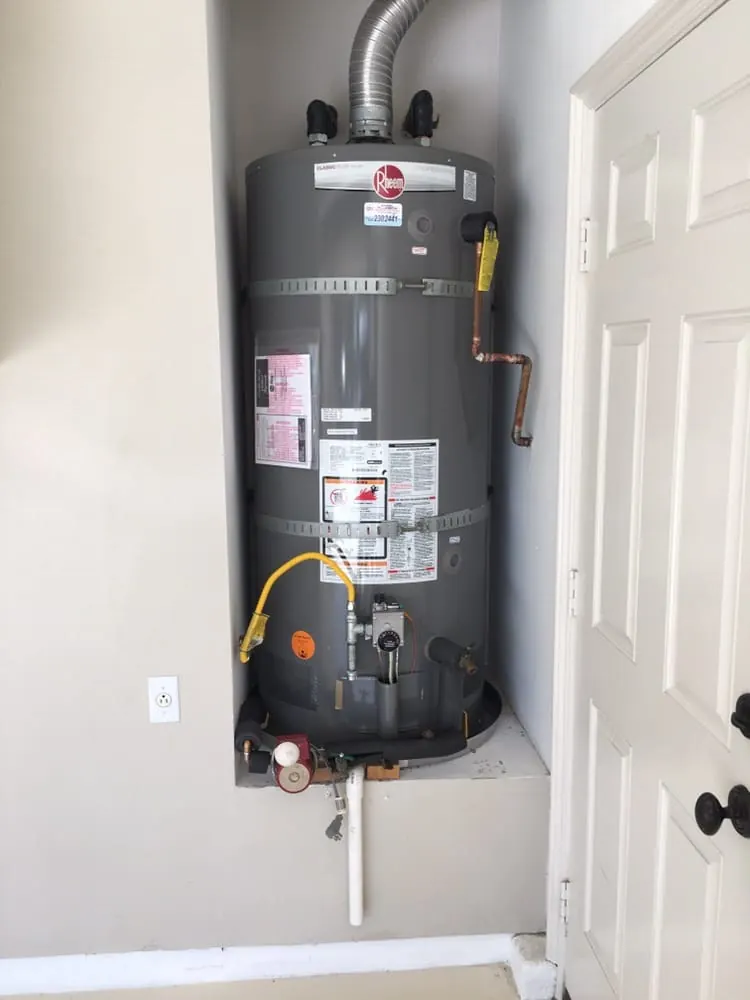
A bigger heater won't fix that. The wait is the cold water sitting in the pipe between the heater and the faucet, and it grows with the length of the run. A larger tank helps with running out, not with how fast hot water arrives.
Your home's decade and what to look at
The same census estimates break 92130 down by year built. The median home dates from 2001.
- 1980s, about 19%
- An original 1980s heater would be about 40 years old, so nearly all have been replaced, some more than once. Look at what the last installer left: the gas connector, the shut-off valve and the relief line's discharge.
- 1990s, about 24%
- At least on a second heater by now, often a third. Pressure regulators wear with age, and high pressure is hard on a water heater, so it's worth having water pressure checked along with the tank.
- 2000s, about 30%
- The biggest group. An original tank from this decade is 17 to 26 years old now. If yours still carries the builder's label, plan the replacement before a leak plans it for you.
- 2010 on, about 22%
- The older ones are entering the usual 8 to 12 year replacement window. The newest mostly need their yearly flush.
From Peñasquitos to Carmel Valley
SR-56 runs straight from Rancho Peñasquitos to Carmel Valley's west end at I-5, about six miles as the crow flies. Los Peñasquitos Canyon Preserve, along Carmel Valley's southern edge, links the two neighborhoods as well. The community's history runs from its 1975 plan as North City West to the name Carmel Valley, restored in 1991.
Carmel Valley plumbing questions
Which treatment plant supplies Carmel Valley's water?
The City of San Diego's Miramar Water Treatment Plant, based on the City's service-area map. Miramar's water averaged 242 ppm of hardness in 2025, about 14.1 grains per gallon. The City's system is interconnected, so the annual report is the place to check the latest figures.
What size water heater does a 3,000 sq ft Carmel Valley home need?
At least a 50-gallon tank, and often a 75 if two or more showers run at the same time or there's a large tub. With tankless, the size is a flow rate rather than gallons, based on how many fixtures run at once. Angel works it out on the free estimate.
Should a big Carmel Valley house have two water heaters?
Sometimes. If one floor or wing is far from the garage, a second heater closer to those bathrooms can shorten the wait and split the load. For most houses, one correctly sized unit is simpler to own.
My Carmel Valley home was built in the 1980s. What should be checked with the water heater?
The gas connector and shut-off valve, the relief valve's discharge line, and the home's water pressure. If there's a pressure regulator on the main line, check whether there's also an expansion tank at the heater. These parts are often older than the heater itself.