Stop the water and the heat first
- Close the cold-water supply. The shutoff sits on the pipe going into the top of the heater, usually the one on the right. Turn a round handle clockwise until it stops, or a lever a quarter turn. Now the tank can't refill, so the leak can only lose what's already inside.
- Cut the heat. On a gas unit, turn the knob on the gas control valve to Off. On an electric unit, switch off its breaker in the panel, or unplug it if it's a plug-in model. You don't want a burner firing under a draining tank, or live wiring next to a puddle.
- Protect what's nearby. Lift boxes off the floor and put down towels or a bucket. A heater in an upstairs or hallway closet needs this faster than one on a garage slab, where the water has somewhere to go.
- Find the source. Wipe the tank and the pipes dry, wait a few minutes, and watch where fresh water shows up first. Then call or text Angel and tell him what you saw. A photo helps.
Where is your water heater leaking from?
Work from the top down. Water runs down the outside of the tank, so a puddle at the base doesn't always mean the bottom is the problem. These are the five places it shows up on a tank water heater, from the easiest fix to the one that can't be fixed.
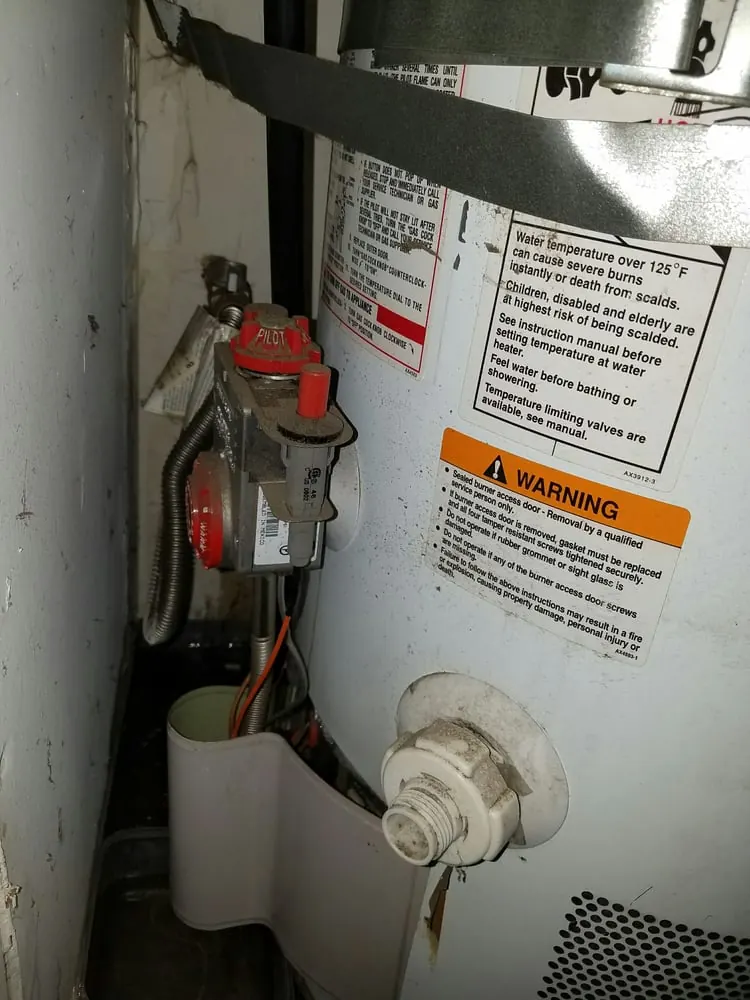
1. The top: hot and cold connectors
Two flexible lines join your house pipes to the top of the tank. They wear out with age, and the threaded fittings they attach to can corrode, especially where copper meets the steel tank. A slow drip up here trickles down the side of the jacket and collects underneath, which is why a top leak often gets mistaken for a bottom leak.
Fixable? Yes. A new connector or fitting stops it. If both lines are original on an older heater, it makes sense to replace the pair.
2. The relief valve and its discharge pipe
The temperature and pressure relief valve, or T&P valve, sits on the top or upper side of the tank, with a pipe running down toward the floor or out through the wall. It's built to open when the tank gets too hot or the pressure climbs too high. Water from that pipe means one of two things: the valve is worn and no longer seals, or something really is pushing the pressure up.
The usual culprit is thermal expansion in a home with a pressure regulator or check valve and no working water heater expansion tank. High pressure from the street can do it too; the general plumbing page covers pressure regulators.
Fixable? Yes, by replacing the valve or by fixing what's raising the pressure. Never cap or plug the discharge pipe to stop the drip. That valve is what keeps an overheated tank from becoming dangerous.
3. The drain valve near the floor
The drain valve is the spigot on the front of the tank, low down, used for flushing. Many are plastic. A drip from the spout usually means a grain of sediment is holding it open a hair, which tends to happen after a flush. Water around the body of the valve, where it threads into the tank, points to a valve that's worn or working loose.
Fixable? Usually. A valve that won't seal can be replaced, and a brass hose cap will hold a slow spout drip until then. If the steel around the valve is rusted, though, you're really looking at a tank problem.
4. Under the tank: the tank itself
Under the outer jacket and insulation, a water heater is a glass-lined steel tank. Heat, sediment and time eventually eat through it, most often at the bottom. The signs are water that keeps coming back under the heater after the top is bone dry, rust streaks down the jacket, rusty water from the hot taps, or water appearing from under the jacket or around the burner opening.
On an electric tank, check one thing before assuming the worst: water seeping from behind an element cover can be a failed gasket on the heating element, which is a part, not the tank.
Fixable? No. A tank leaking from its body can't be patched or welded, so the heater has to be replaced. A standard water heater replacement takes Angel about 2 to 3 hours. If the heater is fairly young, find the label and the receipt: a leaking tank is exactly what a water heater warranty is meant to cover.
5. Condensation that only looks like a leak
A gas water heater burns fuel under a tank of water, and burning gas makes water vapor. When the tank is cold, after a refill, a long run of hot water or on a chilly morning, that vapor condenses inside the flue and drips onto the burner. You hear a sizzle and find a small wet spot that dries up once the tank is back to temperature. Cold supply pipes can also sweat on a humid day.
Fixable? There's nothing to fix if it stops once the heater warms up. If water keeps appearing after the tank is hot, go back to the four spots above.
Two other heaters have their own leak points. A hybrid heat pump makes condensate on purpose and drains it through a small tube, so a clogged tube can overflow around the unit; see hybrid water heaters. Leaks on wall-mounted units are covered under tankless water heater repair.
Gas or electric water heater leaking: what's different
Not much. Both have the same connectors, relief valve, drain valve and tank, and they fail the same way. Two details differ.
- Gas: water dripping onto the burner can snuff out the pilot, so a leak and a cold shower often arrive together.
- Electric: the element covers are where the wiring lives. If water is anywhere near them, leave the breaker off until everything is dry and checked.
If the leak came with other trouble, like no hot water or strange noises, the symptom guide on the water heater repair page matches each one to its likely cause.
That's gas, not water, and it's a different emergency. Don't touch light switches or try to relight the pilot. Get everyone out of the house and phone SDG&E or 911 once you're outside. After the gas side has been checked and made safe, a leaking connector between the gas line and the heater is a replaceable part.
Water heater leak repair: what to expect
Text Angel a photo of where it's wet and a photo of the label. From those he can usually tell whether you're likely looking at a part or a new heater. On site he dries everything off and traces the water to where it starts. If it's a connector or fitting, that's a repair. If it's the tank, he'll go over your replacement options, including whether to stay with the same kind of heater.
A small leak is the best time to call. Nothing has soaked into the drywall yet, and you get to make the decision instead of the tank making it for you.
Leaking water heater questions
Is it safe to keep using a water heater that's leaking?
A slow drip from a top connector can usually wait a short while with a bucket under it, but get it looked at soon. If water is coming from the tank itself, near the burner or near the electrical parts, shut the heater down. Tank leaks only grow, and some give way all at once.
Can a leaking water heater tank be patched or sealed?
No. Once the steel corrodes through, the metal around the hole is thin as well, and no sealant holds up to constant heat and pressure. The fix for a leaking tank is a new water heater. Leaks at the connectors, fittings and valves are a different story and can be repaired.
Why did my water heater start leaking right after it was flushed?
It's almost always the drain valve. Sediment stirred up by the flush can lodge in the valve so it can't close tightly, and an old plastic valve can crack when it's opened for the first time in years. Opening and closing it once more can clear the debris; if it still drips, the valve needs replacing.
Can a leaking water heater explode?
A leak on its own won't make a tank explode. The real danger is heat and pressure building with nowhere to go, which is exactly what the relief valve prevents. That's why a dripping relief valve should be checked, not plugged, and why a heater with a capped or missing discharge pipe needs attention right away.
Why is there water under my gas water heater only on some mornings?
That's often condensation. When the tank is cold, after heavy hot water use overnight or on a cool morning, the burner's exhaust condenses inside the flue and drips down. It stops once the water is back up to temperature. If the floor is still wet after the heater has been running for a while, look for a real leak.