What comes out of a Peñasquitos tap
Peñasquitos gets City of San Diego water, treated at one of three plants. The service-area map in the City's 2025 Annual Drinking Water Quality Report puts the whole northern part of the city, Peñasquitos included, in the Miramar plant's territory. The zones where two plants overlap are far to the south, so the Miramar column of that report is the one to read here.
- 2025 average hardness
- 242 mg/L, which is the same as 242 ppm, or about 14.1 grains per gallon.
- Lowest to highest
- 200 to 285 mg/L across the year (11.7 to 16.6 grains).
- How hard that is
- Very hard. The U.S. Geological Survey draws that line at 180 mg/L, and even Miramar's lowest 2025 reading sat above it.
- Why it moves
- The City imports most of its supply as a blend of Colorado River and State Water Project water, and says the ratio of sources changes through the year.
What 14 grains a gallon means for a water heater in 92129
Hardness is calcium and magnesium dissolved in the water, and heat is what pulls it back out. The USGS puts it plainly: heating hard water forms solid calcium carbonate deposits. In a tank, they collect on the bottom as sediment.
Some rough math with the 2025 average: a 50-gallon tank holds about 189 liters, so every refill brings in around 46 grams of hardness, a bit over an ounce and a half measured as calcium carbonate. A household that runs through roughly a tankful of hot water a day sends more than 35 pounds of it through the heater in a year. Most of that leaves through the taps. Whatever settles stays put until someone flushes it out.
That's the case for a yearly tank flush on any heater in the neighborhood, and for yearly descaling if you've gone tankless, where the same minerals coat a narrow heat exchanger instead of a tank floor. White grit in faucet aerators and chalky crust on the fittings above the tank are early signs.
Peñasquitos houses, and the heater in the garage
Developer Irvin Kahn bought the 14,000-acre rancho in 1962, and the City annexed most of it in 1964. The houses came after that. Of the roughly 19,300 homes in ZIP 92129, Census Bureau estimates for 2020–2024 date about 27% to the 1970s, 34% to the 1980s and 18% to the 1990s. About two in three are detached single-family houses.
In a detached tract house from those decades, the water heater usually stands in the garage, the easiest kind of swap. Tanks usually last around 8 to 12 years, so a house finished in 1985 is rarely on its first heater, or even its second. Each new tank inherits the setup around the old one, and that setup is what Angel checks during a water heater replacement in Rancho Peñasquitos:
- Gas connector and valve. Every gas install gets new ones, so a decades-old connector never gets reused.
- Straps and platform. Both have to fit the new tank, not the last one.
- Vent, relief line and drip pan. Reconnected or replaced as part of the install.
- The pressure regulator. If the house has one, you likely need an expansion tank too. More below.
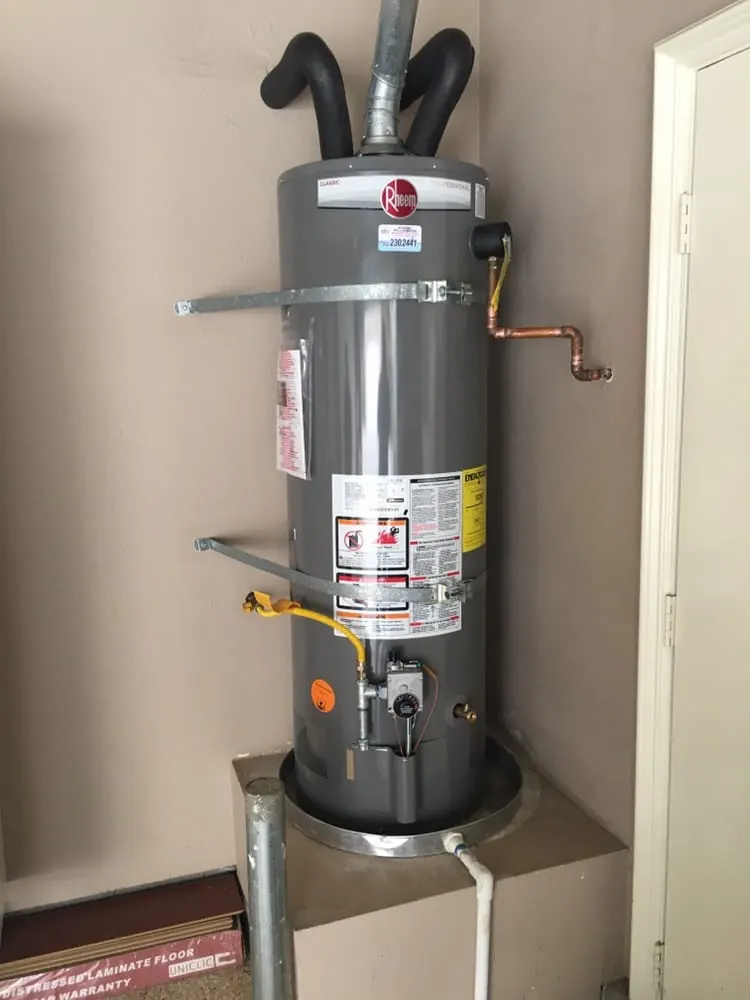
Size goes by the house, not by how many people live in it. Up to about 1,600 square feet (two or three bedrooms) usually means 40 gallons; bigger homes need 50 or more. A tank-for-tank swap takes about 2–3 hours, and the old heater leaves with Angel.
Canyons, ridges and water pressure
The City describes Peñasquitos as a community of numerous canyons, hillsides and ridges, topped by Black Mountain at about 1,500 feet. It also says water pressure varies across San Diego with location and demand, so the pressure at your meter depends partly on where your street sits.
Two points from the City's meter and water pressure page are worth knowing. The California Plumbing Code requires a pressure regulator when pressure in your area is above 80 psi, and the regulator is the property owner's responsibility. The City also names a faulty regulator on the property as the most common cause of a sudden jump in pressure.
That ties back to the water heater. A working regulator closes off your plumbing, so when heated water expands, it has nowhere to go. That's the job of an expansion tank. Banging pipes or a relief valve that drips after each heating cycle are good reasons for a pressure and leak check.
Ask the City. A Public Utilities crew will test the pressure at the fire hydrant nearest your home and report back. If the street is normal and your house isn't, the problem is on your side of the meter.
Getting around 92129
This is home base, so the map has no line to draw. Black Mountain Road runs north to south, Carmel Mountain Road and Rancho Peñasquitos Boulevard east to west, with SR-56 through the middle and I-15 on the eastern edge. The neighbors are close: Carmel Mountain across I-15, Rancho Bernardo a few exits north and Mira Mesa to the south.
Rancho Peñasquitos plumbing questions
Which water treatment plant supplies Rancho Peñasquitos?
The City of San Diego's Miramar Water Treatment Plant. The map in the City's 2025 water quality report places Peñasquitos well inside Miramar's service area, away from the zones where plants overlap, so use the Miramar column for hardness and other readings.
Why is this year's hardness number different from last year's?
Because the source water shifts. Most of the City's supply is an imported blend of Colorado River and State Water Project water, and the mix changes through the year. In 2025 alone, Miramar's readings ran from 200 to 285 mg/L. The City publishes a new report every year.
Is my 1980s Peñasquitos house still on its original water heater?
Almost certainly not. With tanks usually lasting around 8 to 12 years, a house that age has typically been through three or four. What matters now is the age of the one in your garage, and a photo of its label sent to (858) 230-2441 is enough for Angel to tell you.
Does my Rancho Peñasquitos home need a water pressure regulator?
Only if the pressure reaching it is high. The California Plumbing Code calls for a regulator above 80 psi, and because pressure in San Diego varies with location, the answer depends on your street. If your home does have one, that's also the reason its water heater needs an expansion tank.