Poway's water: the city's own plant, and very hard
The City of Poway owns and runs the Lester J. Berglund Water Treatment Plant, built in 1978. Nearly all the raw water it treats is imported: in 2025, 99.5% came from the San Diego County Water Authority (Colorado River and State Water Project water), and the rest was rain caught in Lake Poway. The city's 2025 water quality report lists these numbers:
| Measure (2025) | Imported water | Lake Poway water |
|---|---|---|
| Total hardness, as calcium carbonate | 218 ppm (range 214–223) | 237 ppm |
| Calcium | 53 ppm | 53 ppm |
| Magnesium | 20 ppm | 26 ppm |
| Total dissolved solids | 485 ppm | 560 ppm |
218 ppm works out to about 12.7 grains per gallon. The USGS scale calls anything above 180 ppm very hard, so Poway sits well inside that band.
What that does inside a Poway water heater
Heat drives calcium and magnesium out of the water, and the hotter the water, the more comes out. In a tank, they settle on the bottom as sediment the burner has to heat through, which is the popping an older tank makes. In a tankless unit, they coat the heat exchanger until flow drops and error codes start.
With water this hard, the yearly tank flush is real maintenance, not a nice extra. A tankless unit needs its descaling at least once a year. Keeping the thermostat around 120°F rather than higher also slows the buildup.
A Poway plumber's view of 1970s and '80s houses
Poway became a city in December 1980, but most of its houses are older than that. The city's housing element puts 34.8% of homes in the 1970s and another 20.4% in the 1980s, so more than half the town was built in those two decades. In 2019, about 79% of Poway's housing was single-family.
Tanks usually last around 8 to 12 years, so a house from 1975 is on its fourth or fifth water heater. What the heater connects to is often original. On a replacement in a house this age, check these while the water is off:
- The shut-off valve above the heater. One that sticks or won't close fully should go before you need it in a hurry.
- The pressure regulator on the main line. An original one is decades old, and high pressure wears out a new tank and every faucet faster. See water pressure and regulators.
- The vent pipe. It gets cut and refit with every new heater, and should rise steadily with tight joints.
- The supply pipes. They're 40 to 55 years old. Repeat pinhole leaks are a reason to read up on repiping.
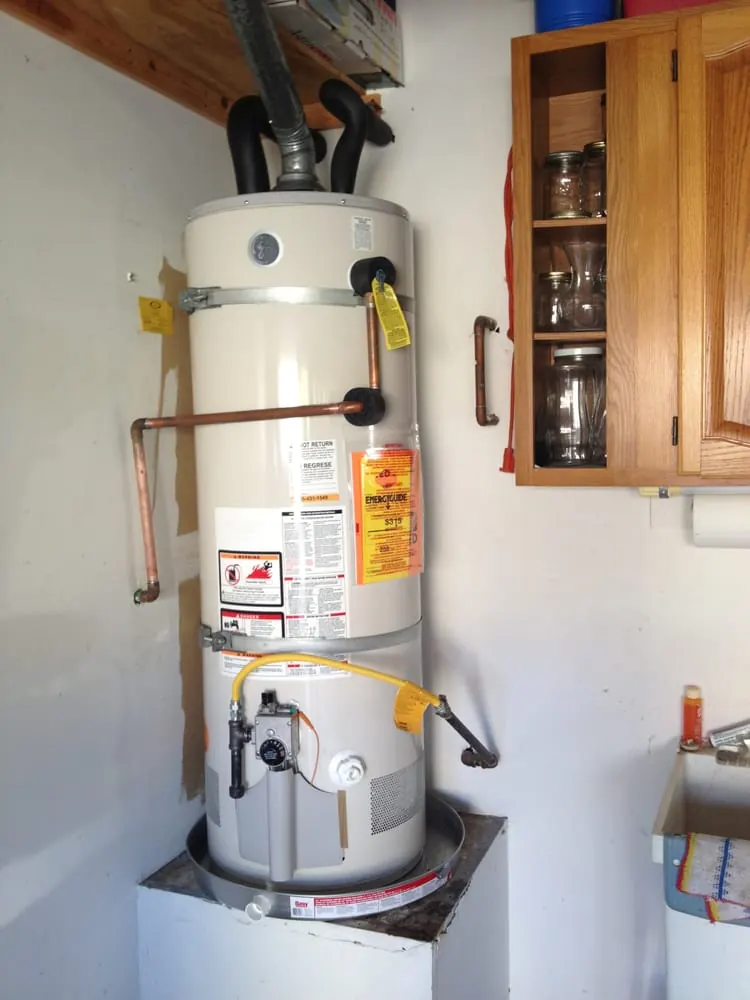
Water heater replacement in homes rebuilt after 2007
The Witch Creek Fire reached Poway in October 2007 and burned 7,247 acres inside the city, including Lake Poway Park and the Blue Sky Ecological Reserve. Rod Gould, Poway's city manager at the time, wrote afterward that ninety families lost their homes and six more homes were badly damaged.
A rebuilt house got its plumbing and water heater during the rebuild. If that heater went in around 2008 to 2010 and was never replaced, it's 15 years old or more, past the age most tanks reach, with Poway's hard water leaving sediment in it the whole time. Planning a replacement beats finding water on the garage floor.
Big Poway lots: long runs, yard lines and septic
Poway's zoning runs from lots of about 4,500 square feet up to rural parcels of 1 to 40 acres. The bigger the lot, the more pipe.
- Long hot-water runs
- In a long single-story house with the heater at the garage end, hot water takes a while to reach the far bathroom. Moving the heater, or a tankless unit closer to the bathrooms, is worth raising on the free estimate.
- Yard lines and far hose bibs
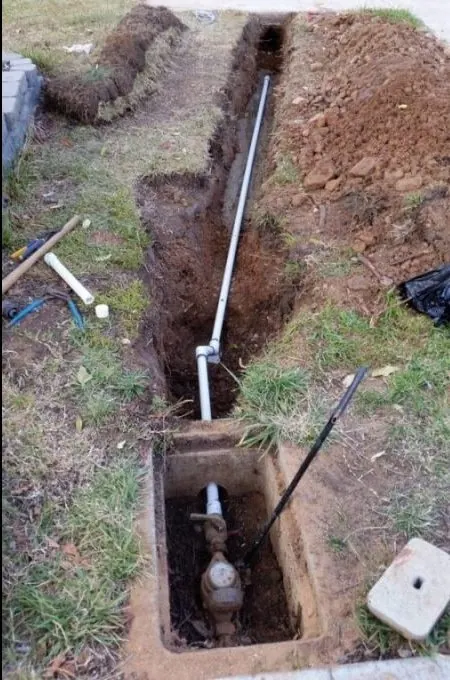
- Poway allows horses and other large animals on lots of 10,000 square feet or more, so some properties have water running out to a barn, an arena or a far spigot. If the bill jumps while nothing is running, the meter test on the leak inspection page tells you whether that buried pipe is leaking before anyone digs.
- Septic instead of sewer
- Not every Poway home is on the sewer. The city's 2025 Lake Poway watershed survey notes that the High Valley community near the lake uses septic systems. If that's you, see the FAQ below before adding a garbage disposal.
From Peñasquitos, the drive is a straight shot: across I-15 and east on Poway Road.
Poway plumbing questions
How hard is the tap water in Poway?
The City of Poway's 2025 water quality report puts total hardness at 218 ppm for the imported water that made up 99.5% of the supply, about 12.7 grains per gallon. Lake Poway water tested slightly higher at 237 ppm. Both count as very hard on the USGS scale, which is why Poway tanks need a yearly flush and tankless units a yearly descale.
Does Poway's treatment plant soften the water?
No. The Berglund plant uses coagulation, settling, filtration and disinfection, which remove particles and germs but not dissolved calcium and magnesium. The hardness in the imported water reaches your tap. Plan on regular flushing and descaling instead of expecting the plant to handle scale.
My Poway house was rebuilt after the Witch Creek Fire. Is the water heater due?
If it's still the heater from the rebuild, probably. A tank installed around 2008 to 2010 is now past the 8 to 12 years most tanks last. Check the label: the serial number holds the manufacture date. Text Angel a photo and he'll tell you how old it is.
Can I have a garbage disposal on a septic system in Poway?
Many septic homes do, but a disposal sends ground food into the septic tank, where it adds to the solids that have to be pumped out. Ask whoever services your septic system whether your tank is sized for it and whether it should be pumped more often. If they're fine with it, the disposal goes in like any other.