Why tankless water heaters scale up in San Diego
Most of San Diego's water is imported from the Colorado River and Northern California, and it arrives hard, carrying plenty of dissolved calcium and magnesium. When hard water is heated, some of those minerals drop out and stick to the hottest surface they touch.
In a tank, that surface is the bottom of the tank, where sediment piles up. In a tankless unit, it's the inside of the heat exchanger: a run of narrow tubing that water rushes through while a burner fires underneath. Scale coats that tubing like the inside of an old kettle. It insulates the water from the heat, narrows the passages and makes the exchanger run hotter than it was designed to.
For a while the unit compensates. Then the signs show up: hot water that takes longer to arrive, a temperature that drifts, a shutdown in the middle of a shower, and finally an error code. Left long enough, the heat stress can crack the exchanger, which is the most expensive part of the heater.
Tankless water heater maintenance: what a descaling service involves
Descaling at least once a year is the core of tankless maintenance. It takes a circulating pump, hoses, descaling solution and a pair of service valves on the unit's water connections. A service visit runs like this:
- Isolate the unit. Gas and power are shut off, and the hot and cold service valves are closed so the heater is cut off from the house plumbing.
- Connect the pump. Hoses from the pump attach to the service valve ports, with a bucket of descaling solution in the loop.
- Circulate. The solution cycles through the heat exchanger long enough to dissolve the scale lining it.
- Rinse. Clean water runs through to flush out the solution and the loosened scale.
- Clean the inlet screen. The small filter where cold water enters catches grit and scale flakes. It comes out, gets rinsed and goes back in.
- Restart and check. The valves reopen, air is purged, and Angel watches the unit fire and checks temperature and flow at a tap.
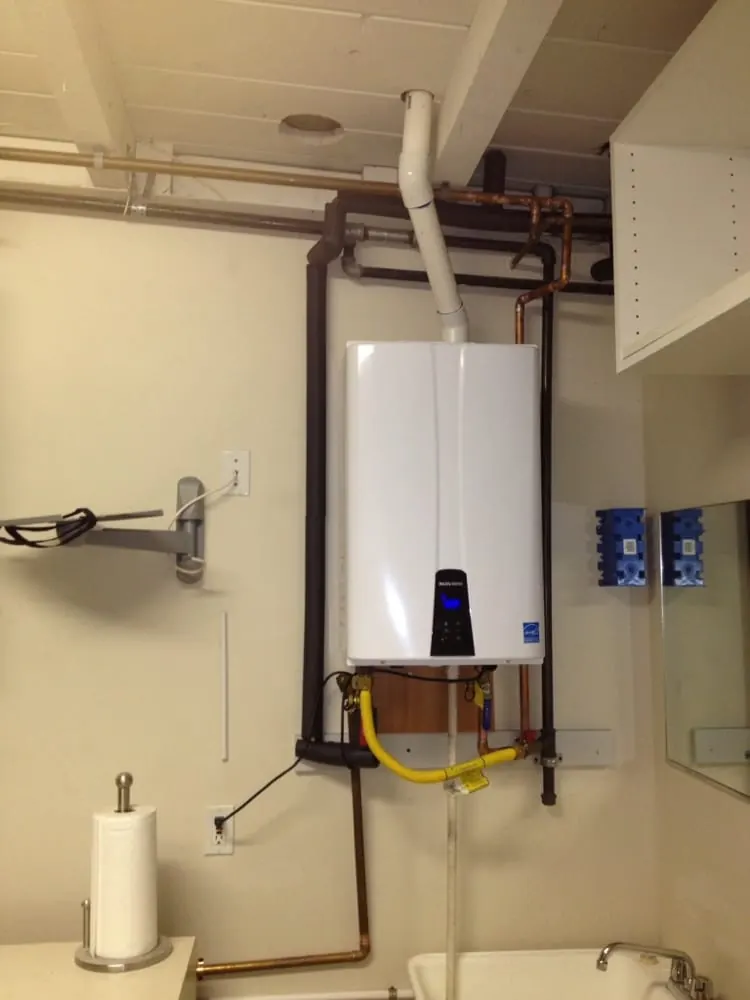
Some older installs went in without them. Without service valves, every descaling means opening up the water connections. Adding a set once makes each yearly service straightforward after that.
What you can keep an eye on between services
- The vent and air intake outside. Leaves, plants and wasp nests block them. A clear terminal is a happy fan.
- Lint and dust. In a laundry room or garage, units that draw combustion air from the room pull lint in with it. Keep the area around the heater clean.
- The display. If a code shows up, write it down before you reset anything. It's the most useful clue you can give Angel.
- Small changes. Hot water taking longer, or temperature swinging at one shower, are early signs of scale or a dirty inlet screen.
Tankless repair: where problems usually start
When a tankless unit acts up, it usually falls into one of these groups. Most are repairable once the cause is confirmed.
Scale and overheating
Temperature drops under heavy use, the unit shuts off mid-shower, or an overheat code appears. A descale often fixes it outright. Years of scale can leave the exchanger damaged.
Ignition and flame
The unit clicks but won't light, or lights and drops out. Look at the gas supply, a dirty flame rod, the igniter or the gas valve. A gas line too small for the burner shows up here too.
Flow and the inlet screen
Weak hot water pressure, or a unit that won't fire at a small faucet. A clogged inlet screen, scale or a failing flow sensor are the usual suspects.
Venting, fan and condensate
A vent or air code, a noisy fan, or shutdowns. A blocked vent terminal, a tired fan motor, or condensate backing up on a condensing model.
Sensors and the control board
Temperature sensors, flow sensors and boards wear out, and a power surge can take one out. Once testing points to the part, it's a swap.
Water under the unit
A fitting, a service valve, the pressure relief valve or, worst case, the heat exchanger. Where it drips from decides what the fix is.
Tankless error codes, in general terms
Every brand uses its own codes, and the same number can mean different things on a Navien, a Noritz and a Rheem. Your owner's manual or the manufacturer's website lists the codes for your exact model. What helps most is knowing what kind of problem a code points at:
| Kind of code | What it usually points to | What you can do |
|---|---|---|
| Ignition failure or flame loss | Gas supply, the igniter, the flame rod, or gas pressure too low for the burner | Make sure the gas valve is open and other gas appliances work, then reset once |
| Overheating or high exchanger temperature | Scale inside the exchanger or restricted water flow | Don't keep resetting it. It usually needs descaling |
| Maintenance or scale reminder | Some units track run time or sense scale and ask for service | Book the yearly descaling |
| Vent, fan or air pressure | A blocked vent or intake, a fan problem, or condensate backing up | Check the outside vent for debris or nests |
| Sensor or communication fault | A failed sensor, a loose connection or the control board | Note the code and call; it needs testing |
One reset is reasonable. Clearing the same code over and over hides the cause, and on an overheating unit it keeps stressing the heat exchanger every time it fires.
Warranty, records and when a new unit makes sense
Tankless heat exchangers often carry a longer factory warranty than the rest of the unit, but manufacturers commonly exclude damage caused by scale or skipped maintenance. Keep a record of every descaling, and see the water heater warranty page for what coverage usually looks like. If an exchanger has failed outside warranty, putting that money toward a new unit is often the better call, and the tankless installation page covers what a replacement involves. Tank owners can find the yearly flush on the water heater maintenance page.
Tankless service questions
How often should a tankless water heater be descaled?
At least once a year. San Diego's hard water builds scale quickly, and a busy household runs more water through the unit, so the yearly service matters more here than in soft-water areas. Some units also show a maintenance reminder when they sense scale.
Can I flush a tankless water heater myself?
If the unit has service valves and you're comfortable with a pump, hoses and the manufacturer's instructions, it can be done. The risks are skipping a step on a gas appliance, using the wrong solution or leaving air in the unit. Having it done also gets the inlet screen, vent and ignition looked at in the same visit.
Why does my tankless water heater go cold in the middle of a shower?
The usual causes are scale making the unit overheat and shut itself down, a flow rate that dips below what the unit needs to stay lit, or a gas supply that can't keep up when another gas appliance runs at the same time. A short burst of cold right after turning the water back on is different, and usually normal.
Why won't my tankless heater turn on at the bathroom sink?
Tankless units need a minimum flow of water before they fire. A faucet opened only a little, or an aerator clogged with scale, may not reach it. Open the tap further; if it still runs cold while other taps run hot, the aerator or the unit's flow sensor is worth checking.
Does skipping tankless maintenance affect the warranty?
It can. Manufacturer warranties commonly exclude damage from scale or lack of maintenance, and hard water is the usual cause of that damage. Keep a record of each descaling, and read your model's warranty terms so you know what it asks of you.