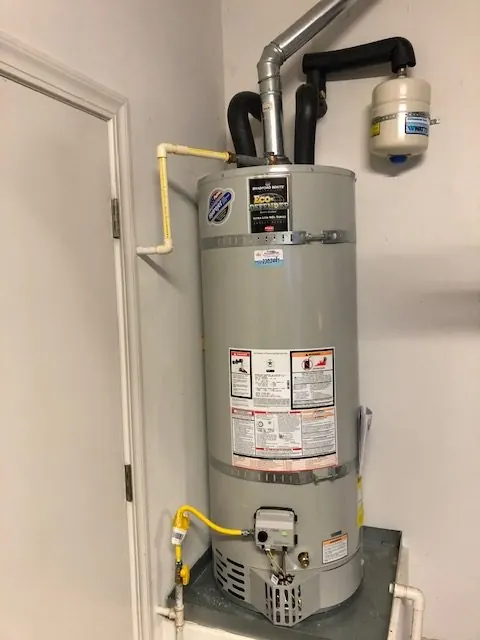
What thermal expansion does in a closed system
Water grows when you heat it. A 50-gallon tank filled with cold water gains roughly half a gallon of volume by the time it reaches shower temperature, and because water doesn't compress, that half gallon has to go somewhere.
In an open plumbing system, it simply backs out through the meter toward the street. Many homes aren't set up that way anymore. A pressure-regulating valve where the main enters the house, or a check valve or backflow preventer at the meter, lets water in but not back out. That makes it a closed system, and in a closed system every heating cycle pushes the house pressure up.
With nowhere to go, the pressure climbs until something gives. Usually that's the relief valve on the water heater, which starts to drip or spit. Over months and years the same spikes wear on faucet cartridges, toilet fill valves, supply lines and the tank itself.
The parts involved
- Pressure regulator (PRV)
- A bell-shaped brass valve on the main line, often near the front hose bib, that drops street pressure to a safe level for the house. By design it also keeps water from flowing back out toward the street.
- Check valve or backflow preventer
- A one-way valve, sometimes added by the water utility at the meter, that keeps water from the house from flowing back into the public supply.
- Expansion tank
- A small steel tank divided inside by a rubber diaphragm, with water on one side and pressurized air on the other. Expanding water pushes into it and squeezes the air, instead of spiking the pressure in your pipes.
- T&P relief valve
- The safety valve on the water heater, set to open at high pressure or temperature. One that drips after every heating cycle is often the first sign of uncontrolled thermal expansion.
Does your water heater need an expansion tank?
If your home has a closed system, an expansion tank is highly recommended. The plumbing code calls for thermal expansion control on closed systems, and an expansion tank is the usual way to provide it. So the real question is whether yours is closed. Signs that it is:
- There's a pressure regulator. Find where the main water line comes out of the ground and into the house. A brass, bell-shaped valve with an adjusting bolt on top is a PRV.
- There's a check valve at the meter. Look in the meter box, or ask your water provider whether one was installed.
- The relief valve drips now and then, often after a long shower, or overnight while nobody is using water and the heater is catching up.
- Pressure climbs while the heater runs. A pressure gauge from the hardware store, screwed onto a hose bib, will show it creeping up during a heating cycle and dropping as soon as a tap opens.
The fuel doesn't matter. A gas water heater and an electric water heater expand water the same way, so both need an expansion tank in a closed system, and a hybrid heat pump tank is no different. If the house pressure is high even when nothing is heating, that's a regulator problem rather than an expansion problem; water pressure and pressure regulators are covered on the general plumbing page.
Signs your expansion tank has failed
Expansion tanks wear out, usually well before the water heater does. Once the diaphragm tears or the air charge leaks away, the tank fills with water, a condition called waterlogged, and stops absorbing anything. The pressure problem comes straight back.
| Check | Healthy tank | Failed tank |
|---|---|---|
| Knock on it | Hollow at the top, solid only near the water connection | Solid and heavy-sounding all over |
| Press the air valve for a second | A hiss of air | Water comes out, so the diaphragm has failed |
| Watch the relief valve | Stays dry | Drips after the heater runs |
| Look at the shell | Clean and dry | Rust, or weeping at the threaded connection |
| House pressure | Steady through a heating cycle | Climbs as the heater runs, falls when a tap opens |
The air valve on top looks like the one on a bike tire. Press it only briefly, since every press lets out some of the charge. An expansion tank usually lasts somewhere around 5 to 10 years. Topping up the air can buy time if the diaphragm is intact, but a tank that spits water from its air valve needs replacing.
How an expansion tank is installed on the cold line
Installing an expansion tank for a water heater is a short job when the cold line is easy to reach. Replacing an old one follows the same steps, usually reusing the existing tee.
- Size it. The tank is matched to the heater's capacity and the home's water pressure. A typical 40 or 50 gallon heater at normal pressure takes a small tank of about 2 gallons; a larger heater or higher pressure calls for more.
- Set the air charge first. With a tire gauge on the air valve, the tank's pre-charge is set to match the house's static water pressure. Tanks come from the factory at a standard charge that may not match your house, and a mismatched tank does a poor job.
- Shut off the water and relieve the pressure by opening a tap, so the line can be opened safely.
- Tee into the cold supply between the shutoff valve and the heater. Cooler water is easier on the rubber diaphragm, and right beside the heater the tank takes in the extra water as soon as it's pushed out.
- Support it. Full of water, even a small tank is heavy, so it gets strapped or bracketed to the wall rather than left hanging on the pipe.
- Turn the water back on, check every joint, and confirm the relief valve stays dry through a full heating cycle.
If you're getting a new water heater anyway, that's the easiest time to add an expansion tank, since the cold connection is already being redone. See water heater replacement for the rest of what happens on install day.
What affects expansion tank installation cost
The size of the tank, whether there's already a tee in the cold line or a new connection has to be made, how much room there is to mount and support it, and whether it's done on its own or alongside a water heater replacement. Angel will price it on a free estimate.
Expansion tank questions
Does an expansion tank go on the hot or cold side of the water heater?
The cold side, on the supply line feeding the heater, between the shutoff valve and the tank. Expanding water backs up into the cold line anyway, and the rubber diaphragm lasts longer in cooler water than it would on the hot side.
How long does a water heater expansion tank last?
Usually around 5 to 10 years. Hard water, high house pressure and an air charge that was never set correctly all shorten that. Check it whenever the relief valve starts dripping, and whenever the water heater itself gets replaced.
What pressure should an expansion tank be charged to?
The same as your home's static water pressure, measured with no water running. If the regulator holds the house at 60 psi, the tank is charged to 60 psi. Set too low, it fills with water before it can absorb anything; set too high, it barely takes any in.
Do tankless water heaters need an expansion tank?
Less often. A tankless unit holds very little water at a time, so there's far less to expand than in a 40 or 50 gallon tank. Some manufacturers still call for one when the home has a closed system, so the answer depends on the model and how the plumbing is set up.
Can an expansion tank be added to an existing water heater?
Yes, and you don't need a new heater to do it. The tank tees into the cold supply line beside your current heater and gets mounted to the wall. If your relief valve started dripping after a pressure regulator went in, adding one is often the fix.