The desalination plant is in Carlsbad. Most of the water isn't.
The Claude "Bud" Lewis Carlsbad Desalination Plant began commercial operation in 2015 on the Encina Power Station site. It makes up to 50 million gallons a day, about 10 percent of the region's water, says the City of Carlsbad. The San Diego County Water Authority buys the output and sends it through its aqueducts to agencies countywide.
For the Carlsbad Municipal Water District (CMWD), that was 18 percent of the 2025 supply, blended into the treated water it buys (2025 Urban Water Management Plan). The other 82 percent was imported water treated at Metropolitan's Skinner plant or the Water Authority's Twin Oaks Valley plant (2025 Water Quality Report).
82% imported
Skinner plant water averaged 230 ppm hardness in 2025 (228–232), about 13.5 grains per gallon. No hardness is listed for the Twin Oaks share.
18% desalinated
The plant's water averaged 60.5 ppm (54.4–69.0), about 3.5 grains, right where soft ends and moderately hard begins.
CMWD publishes no single hardness for the blend. Weighted 82/18, the two measured sources come to about 200 ppm. That's arithmetic, not a test, but still "very hard" on the USGS scale. The plant in town doesn't make your water soft.
What Carlsbad's water does inside a water heater
One row in CMWD's table is easy to skip: corrosivity, given as a saturation index. Skinner water averaged 0.52 and the desalinated water 0.34. The footnote says a positive number means non-corrosive water with a "tendency to precipitate and/or deposit scale on pipes." Heat pushes the index up, since calcium carbonate dissolves less in hot water, so the scale forms inside your heater.
In a tank, it piles up on the bottom between the water and the burner, and can clog the drain valve. In a tankless unit, it coats the heat exchanger's narrow passages. For Carlsbad water, that means:
- Flush a tank yearly, from year one. Old sediment packs down and won't drain (see water heater maintenance).
- Descale a tankless unit every year and clean its inlet screen at the same visit, as tankless repair and descaling explains.
- Plan scale protection before a new tankless goes in. Check the maker's hardness limit against 230 ppm.
- Keep the tank near 120°F. Less heat, less scale.
Which Carlsbad water district are you on?
CMWD serves about 82 percent of the city, roughly 96,000 people in 2025. Two other districts cover the southeast, as the city's water district map shows. On any of the three, plan for hard water.
- Carlsbad MWD
- Most of the city, in all four quadrants.
- Olivenhain MWD
- The southeast corner around Rancho Santa Fe Road. Its 2025 report put hardness at 200 ppm.
- Vallecitos WD
- A pocket on the eastern edge, just north of Olivenhain's area. It blends water from several plants, and the San Marcos page has its numbers.
Carlsbad homes, quadrant by quadrant
The city's 2021–2029 Housing Element, using 2018 Census estimates, counts 45 percent of homes built after 1990 and 28 percent after 2000, and the 2000s were the busiest decade. Homes 30 to more than 50 years old cluster in the Village, the Barrio and Olde Carlsbad. In 2019, 55 percent of homes were detached houses, 14 percent attached homes and 29 percent apartments and condos.
| Quadrant | What's there | Water heater notes |
|---|---|---|
| Northwest, 92008 | The Village, the Barrio and Olde Carlsbad: 1950s cottages and bungalows, 1960s ranch houses. | The oldest plumbing. Past 50, the Housing Element says, homes tend to need plumbing work. |
| Northeast, 92010 | Mostly single-family, from older Chestnut Hills to newer Calavera Hills. | Garage heaters, usually a 2–3 hour tank-for-tank swap. |
| Southeast, 92009 | La Costa, home of the resort that opened in 1965, and newer master-planned communities such as Bressi Ranch. | The only quadrant with Olivenhain or Vallecitos water. A heater from the 2000s is due if it hasn't been replaced. |
| Southwest, 92011 | Along the ocean south of the city center, including Aviara. | Outdoor units and vent caps sit in salt air. |
Quadrant notes follow Wikipedia. Condo and townhome heaters often sit in closets, where an electric tank or a hybrid heat pump may fit best. In an older northwest house, leaks that keep moving point toward repiping.
Salt air on the beach side
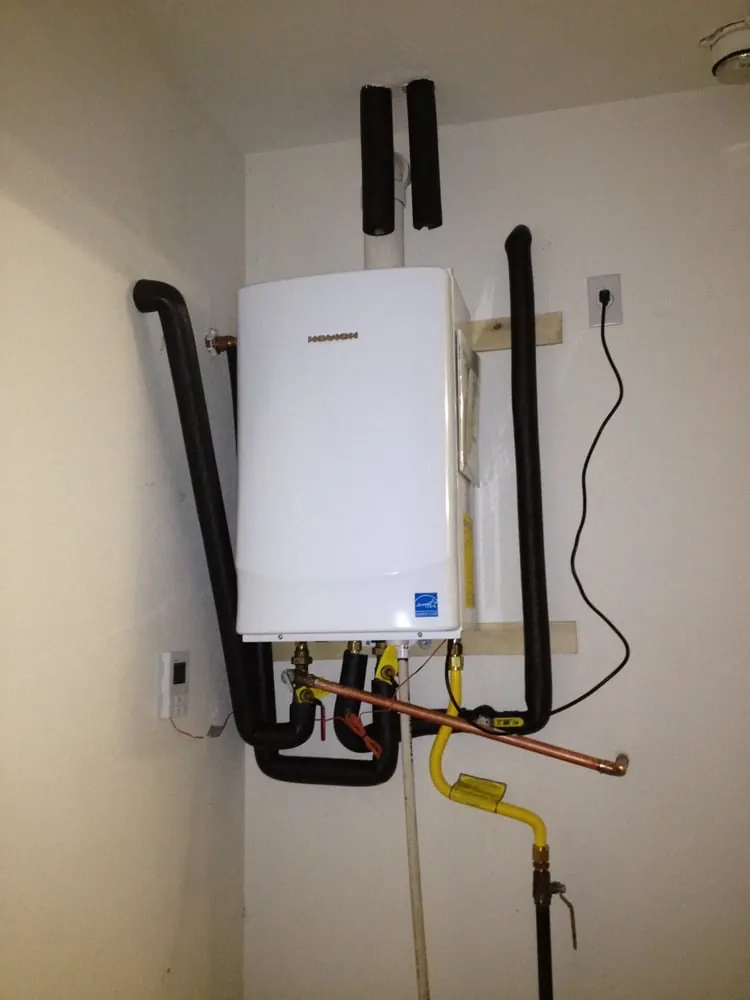
Carlsbad's three lagoons, more than 1,000 acres by the city's count, reach inland from the beach on the west side of town. Salt air there works on anything mounted outdoors: screws, fittings, the vent terminal. Check an outside-wall tankless unit for rust twice a year. For a new tankless installation near the beach, ask about an indoor spot like the one pictured above.
Leaks and garbage disposals in Carlsbad
CMWD's leak page has a local rule of thumb: a family of four using over 16 units in January or February probably has a leak. With every fixture off, a meter that moves in 15 minutes calls for a leak inspection. A jammed garbage disposal can often be freed, but a leaking one gets replaced.
Getting to Carlsbad from Rancho Peñasquitos
SR-56 runs west to I-5, which continues north through Carlsbad with exits from La Costa Avenue to Carlsbad Village Drive. For east La Costa, I-15 north and SR-78 west lead to Rancho Santa Fe Road, which runs south from San Marcos into the neighborhood. In a straight line, south Carlsbad is about 12 miles from Angel's base and the Village about 19.
Carlsbad plumber questions
Does living near the Carlsbad desalination plant mean softer tap water?
No. The plant's water goes into the San Diego County Water Authority's pipelines, not to nearby homes. It was 18 percent of Carlsbad Municipal Water District's 2025 supply, and the imported water measured at Skinner averaged 230 ppm hardness.
Is my La Costa home on Carlsbad, Olivenhain or Vallecitos water?
Carlsbad Municipal Water District serves most of the city. The city's district map puts the southeast corner around Rancho Santa Fe Road on Olivenhain, and a pocket on the eastern edge on Vallecitos. Your water bill names your district.
What does the saturation index in Carlsbad's water report mean for my water heater?
It's the report's corrosivity row: 0.52 for the imported water and 0.34 for the desalinated water in 2025. The report defines a positive index as non-corrosive water that tends to deposit scale. Heat raises it, so the scale ends up in your tank or tankless heat exchanger.
Which Carlsbad homes are most likely to need a repipe?
The oldest, mostly in the Village, the Barrio and Olde Carlsbad, where the city's Housing Element places most homes 30 to more than 50 years old. Repeat pinhole leaks, rusty water or weak flow at several fixtures are the usual signs.