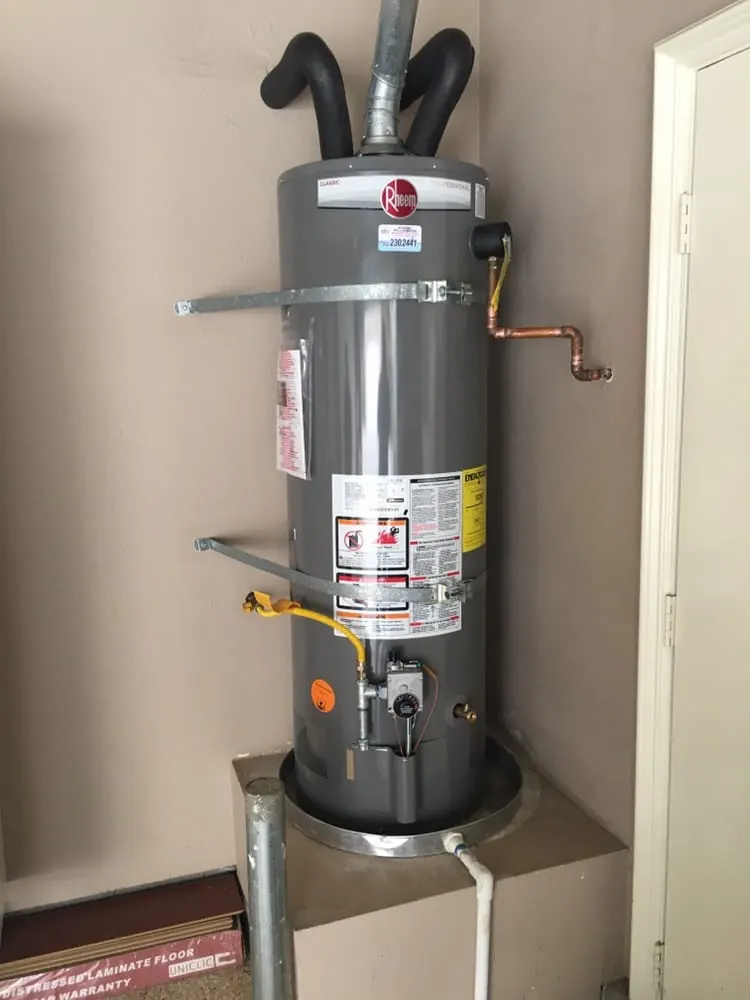
Signs it's time for a new water heater
Tanks rarely quit without warning. These are the signs Angel looks for when someone asks whether to replace now or wait.
- Water coming from the tank itself. A drip from a fitting on top can be fixed. Water seeping out of the bottom seam or the side of the tank means the steel inside has rusted through, and no part will stop it. The leaking water heater guide shows how to tell the two apart.
- Age past about 10 years. Most tanks last roughly 8 to 12 years. San Diego's hard water leaves scale and sediment in the bottom of the tank year after year, which tends to push them toward the short end of that range.
- Brown or rusty hot water while the cold side runs clear. That usually points to the inside of the tank, not your pipes.
- Rumbling that keeps getting louder, even after a flush. Hardened sediment makes the burner or elements work harder and stresses the tank bottom.
- Not enough hot water for the house anymore, because the home or the household has outgrown what the tank was sized for.
- One repair after another on a heater that's near the end of its life anyway. The water heater repair page covers how Angel weighs fixing against replacing.
If none of these fit and the heater only needs a part, a repair is usually the better buy, and Angel will tell you so.
40 gallon or 50 gallon water heater: size it by the house
Most people start with "how many of us live here?" Angel sizes by the house instead: its square footage and bedrooms. People come and go, guests show up for the holidays, and a house keeps its bathrooms when the kids move out, so the house is the steadier measure.
| Your home | Usual tank | Worth knowing |
|---|---|---|
| Up to about 1,600 sq ft, 2–3 bedrooms | 40 gallon | The usual pick for condos, townhomes and smaller single-family homes. Fits most existing platforms and closets. |
| Over about 1,600 sq ft | 50 gallon | Taller or wider than a 40. Check the closet door, the platform and the room around the vent before you decide. |
| Large homes, soaking tubs, several showers at once | 75 gallon, or tankless | A bigger gas burner can mean a bigger vent and gas line. See gas water heaters and tankless installation. |
| Not sure | Decided on the estimate | Angel looks at the house, the space and the heater you have now, then recommends a size. |
Bigger isn't automatically better: a tank keeps all its water hot around the clock, so an oversized one heats water you never use. And if a tank that used to be enough now runs short, have it flushed first. A thick layer of sediment makes a tank behave like a smaller one.
Water heater replacement day, step by step
A straight tank-for-tank swap takes about 2–3 hours. Easy access speeds it up, so it helps to move boxes, bikes and the car away from the heater the night before.
- Shut down and drain. Angel turns off the gas or the breaker, closes the cold-water supply and drains the old tank through a hose. A full 40-gallon tank weighs several hundred pounds, so it gets emptied before it moves.
- Disconnect. The hot and cold connectors come off, then the gas connector, the exhaust vent on gas units, and the T&P discharge line.
- Old tank out. It goes straight to the van. You won't have to deal with it again.
- Set the new heater. A drip pan goes down first, then the new tank, leveled and strapped to the wall the way California code requires for earthquakes.
- Connect everything new. Water connectors, the gas valve and connector, the vent and the T&P line, each covered below.
- Fill, fire up and test. The tank fills with a hot tap open to push the air out, and only then does the burner get lit or the power go on. Every joint gets checked for leaks, and on gas units, the vent for a proper draft.
- Haul-away and clean-up. The old unit leaves with Angel and the area is cleaned up before he goes.
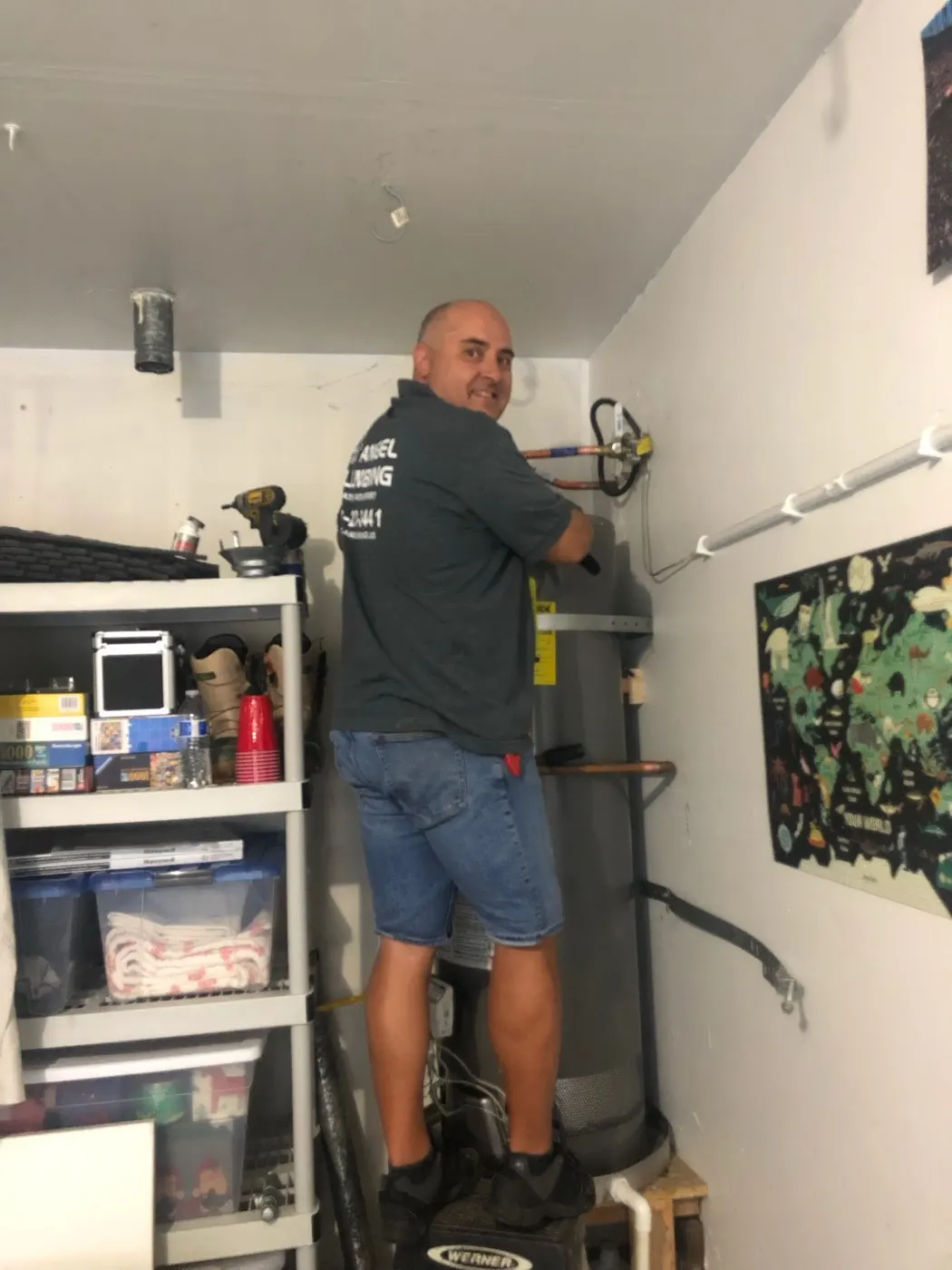
What's included in every water heater installation
The estimate covers the parts that make the install safe and complete, not just the tank. Here's each one and why it's on the list.
- New water heater
- Gas or electric, in the size and model you chose. Angel installs tanks from Rheem, A.O. Smith and Bradford White.
- Hot and cold connectors
- The old flex lines have been under pressure as long as the old tank. New ones remove the most common source of drips on top of a heater.
- Gas valve and connector
- On gas units, the shutoff valve and the flexible line to the heater are new, not reused. Connectors are made to be bent into place once.
- T&P line
- The temperature and pressure relief valve is the tank's safety outlet. Its discharge line is disconnected and reconnected so that if the valve ever opens, hot water is piped away instead of spraying the garage.
- Exhaust vent
- On gas units, the flue is disconnected from the old tank and connected to the new one, so combustion gases leave the house.
- Drip pan
- Catches drips and small leaks under the tank. It won't hold a failed tank's worth of water, but it protects floors and gives you warning.
- Haul-away and disposal
- The old tank leaves with Angel when the job is done. No dragging it to the curb.
Angel does every install himself, so the person who looked at your heater for the estimate is the person who shows up to replace it.
What drives water heater replacement cost
You won't find a price list here, because two homes with the same 50-gallon tank can need very different work. These are the things that move the number. Angel goes through each one on a free estimate, and you get the price before any work starts.
Fuel and model
Gas or electric, and which warranty tier. Longer-warranty models cost more up front. See how water heater warranties work.
Tank size
Going from 40 to 50 gallons, or up to 75, changes the heater price and sometimes the vent and gas line.
Where it sits
An open garage is the simplest job. A tight closet, an upstairs unit or a heater behind stored furniture takes more time.
Code updates
Older installs sometimes lack two straps, a proper relief line or an expansion tank on a closed system. Those get brought up to code with the new heater.
Labor
The labor cost to install a water heater comes down to access and change. A like-for-like swap with the lines already in place is the quickest version.
Water heater installation near you
Angel is based in Rancho Peñasquitos and replaces water heaters throughout San Diego and North County. In many of the area's tract homes the heater sits in the garage, often on a platform, which keeps the swap simple. Older homes and condos more often use a hall or outdoor closet, where fit and venting take more planning. See the service areas.
Water heater replacement questions
Can I replace a 40-gallon water heater with a 50-gallon?
Usually, yes, if the space allows. A 50-gallon tank is taller or wider, so the platform, the closet door and the vent all have to fit the new heater. Angel measures the space on the estimate before you commit.
What happens to my old water heater?
It leaves with Angel. Haul-away and disposal of the old unit are part of every installation, so there's no rusty tank left at the curb and nothing for you to arrange.
How soon is there hot water after a new heater goes in?
Cold water is back right away, and hot water returns as the new tank heats. A gas tank usually needs somewhere around 40 minutes to an hour to heat a full tank from cold; an electric tank often needs closer to two hours. Holding off on laundry and long showers in that window helps.
Should I replace my water heater before it starts leaking?
If it's past about 10 years and showing rust, rumbling or discolored hot water, replacing it on your schedule is easier than replacing it after a leak. You get to choose the model, and there's no water on the floor. If it's younger and working well, there's no reason to rush.
Is a new water heater installation different from a replacement?
A replacement swaps a tank in the same spot with the same fuel. A new installation, or a move to a new location or type, can mean new water lines, a new gas line or vent, or a new electrical circuit. Both start the same way: a free estimate after Angel sees the space.